Pycnogonida |
Pantopoda |
Callipallenidae
Milieu: milieu / Klimaatzone / Diepte / verspreidingsgebied
Ecologie
Benthic. Subtropical
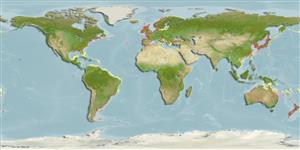
Western Central Pacific, Atlantic Ocean and the Mediterranean: Northern Europe, West Africa.
Lengte bij maturiteit / Grootte / Gewicht / Leeftijd
Maturiteit: Lm ? range ? - ? cm
Chelifiore: well developed, gathers food and use mouth to carry (Ref. 12). Tiny species with neck only half length of cephalic segment. Chelifore fingers equal to or slightly longer than palm, with teeth. Oviger fifth segment long in male, with laterodistal apophysis or knob bearing setae; strigilis with row of tiny fan-shaped denticulate spines, without terminal claw. Legs very slender, with few setae; cement gland openings not evident; propodus with 4 or 5 heel spines; main claw short, well curved; auxiliaries 0.6 length of main claw (Ref. 2115, p. 61).
It is an epibenthic species found on reefs (Ref. 95730), from coastal to upper slope (Ref. 19). Found to exclusively feed on hydroids, starves if no hydroids are present (Ref. 121217).
Levenscyclus en paargedrag
Maturiteit | Voortplanting | Paaien | Eieren | Fecunditeit | Larven
Members of the class Pycnogonida are gonochoric and sexually dimorphic. During copulation, male usually suspends itself beneath the female. Fertilization occurs as the eggs leave the female's ovigers. Males brood the egg masses until they hatch. Life cycle: Eggs hatch into protonymphon larva then to adults.
Child, C.A. 1992 Shallow-water Pycnogonida of Gulf of Mexico. Memoirs of the Hourglass Cruises 9:1-86. Florida Department Natural Resources, Bureau of Marine Resources, Jan. 1992. (Ref. 2115)
Status op de Rode Lijst van het IUCN
(Ref. 130435: Version 2025-2 (Global))
CITES status (Ref. 108899)
Not Evaluated
Not Evaluated
Gevaar voor de mens
Gebruik door de mens
FAO - Publication: search | FishSource |
Tools
Meer informatie
PopulatiedynamicaGroei
Max. leeftijden / maten
Lengte-gewicht rel.
Lengte-lengte rel.
Lengtefrequenties
Massaconversie
Abundantie
LevenscyclusVoortplantingMaturiteitFecunditeitPaaienEierenOntwikkeling van de eierenLarven FysiologieZuurstofverbruik
Menselijk gerelateerdPostzegels, munten, diversen.
Internetbronnen
Schattingen op basis van modellen
Kwetsbaarheid van de visserij
(Ref. 71543) |
(0 of 100). |
Prijsklasse
(Ref. 80766): |
Unknown. |