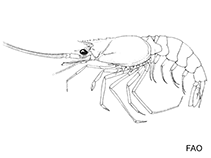
Common names from other countries
Malacostraca |
Decapoda |
Solenoceridae
Environment: milieu / climate zone / depth range / distribution range
Ecology
Benthic; depth range 240 - 1865 m (Ref. 83922). Tropical, preferred 23°C (Ref. 107945); 11°N - 44°S, 86°W - 71°W
Eastern Pacific: Costa Rica to Chiloe, Chile.
Length at first maturity / Size / Weight / Age
Maturity: Lm ? range ? - ? cm Max length : 10.1 cm CL male/unsexed; (Ref. 8); 21.5 cm TL (female)
Benthic species found in muddy bottoms (Ref. 83922). Reported to feed on frenulates (Ref. 112884).
Life cycle and mating behavior
Maturity | Reproduction | Spawning | Eggs | Fecundity | Larvae
Members of the order Decapoda are mostly gonochoric. Mating behavior: Precopulatory courtship ritual is common (through olfactory and tactile cues); usually indirect sperm transfer.
Faxon, W. 1893. (Ref. 21)
IUCN Red List Status
(Ref. 130435: Version 2025-1)
CITES status (Ref. 108899)
Not Evaluated
Not Evaluated
Threat to humans
Human uses
Fisheries: commercial
FAO - Fisheries: landings | FishSource | Sea Around Us
Tools
More information
Population dynamicsGrowth
Max. ages / sizes
Length-weight rel.
Length-length rel.
Length-frequencies
Mass conversion
Abundance
Life cycleReproductionMaturityFecunditySpawningEggsEgg developmentLarvae PhysiologyOxygen consumption
Human RelatedStamps, coins, misc.
Internet sources
Estimates based on models
Preferred temperature
(Ref.
115969): 4.4 - 6.7, mean 5.4 (based on 18 cells).
Fishing Vulnerability
Low vulnerability (12 of 100).
Climate Vulnerability
Low to moderate vulnerability (28 of 100).
Nutrients : Calcium = 109 [35, 184] mg/100g; Iron = 1.59 [1.21, 1.97] mg/100g; Protein = 20.2 [19.2, 21.3] %; Omega3 = 0.285 [0.185, 0.386] g/100g; Selenium = 48.3 [-31.7, 128.3] μg/100g; VitaminA = 0 μg/100g; Zinc = 1.79 [1.17, 2.40] mg/100g (wet weight); based on
nutrient studies.