Gastropoda |
Littorinimorpha |
Capulidae
Environment: milieu / climate zone / depth range / distribution range
Ecology
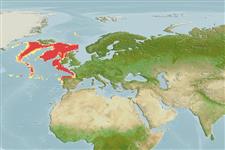
Benthic; depth range 156 - 2100 m (Ref. 3446), usually 156 - 1417 m (Ref. 3446). Temperate; 78°N - 39°N, 72°W - 0°W (Ref. 3446)
Northern Atlantic and the Mediterranean Sea: North America.
Length at first maturity / Size / Weight / Age
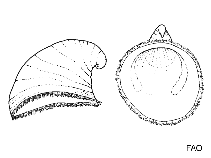
Maturity: Lm ? range ? - ? cm Max length : 1.7 cm TL male/unsexed; (Ref. 3446)
Life cycle and mating behavior
Maturity | Reproduction | Spawning | Eggs | Fecundity | Larvae
Members of the order Neotaenioglossa are mostly gonochoric and broadcast spawners. Life cycle: Embryos develop into planktonic trocophore larvae and later into juvenile veligers before becoming fully grown adults.
Arnaud, P.M. 1974 Contribution à la bionomie marine benthique des régions antarctiques et subantarctiques. Téthys 6(3):467-653. (Ref. 86525)
IUCN Red List Status
(Ref. 130435: Version 2025-2 (Global))
CITES status (Ref. 108899)
Not Evaluated
Not Evaluated
Threat to humans
Human uses
FAO - Publication: search | FishSource |
Tools
More information
Trophic EcologyFood items (preys)
Diet composition
Food consumption
Predators
Population dynamicsGrowth
Max. ages / sizes
Length-weight rel.
Length-length rel.
Length-frequencies
Mass conversion
Abundance
Life cycleReproductionMaturityFecunditySpawningEggsEgg developmentLarvae PhysiologyOxygen consumption
Human RelatedStamps, coins, misc.
Internet sources
Estimates based on models
Fishing Vulnerability
(Ref. 71543) |
Low vulnerability (10 of 100). |
Price category
(Ref. 80766): |
Unknown. |