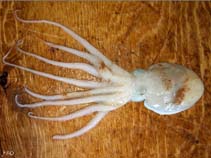
Cephalopoda |
Octopoda |
Eledonidae | Eledoninae
Environment: milieu / climate zone / depth range / distribution range
Ecology
Benthic; depth range 5 - 500 m (Ref. 96968), usually 60 - 120 m (Ref. 96968). Subtropical, preferred 18°C (Ref. 107945); 70°N - 30°N, 26°W - 22°E (Ref. 275)
Northeast Atlantic and the Mediterranean.
Length at first maturity / Size / Weight / Age
Maturity: Lm 11.1, range 7 - 16.5 cm Max length : 55.0 cm TL male/unsexed; (Ref. 96968); max. published weight: 1.2 kg (Ref. 275)
Occurs from sand and mud, to broken rock and rocky reefs (Ref. 96968). Females predominate at depths of 30 to 80 m, males at depths below 100 m (Ref. 275).
Male spermatangia reach ovary before the release of sperms (Ref. 2569). Also Ref. 80232.
Roper, C.F.E., M.J. Sweeney and C.E. Nauen 1984 FAO Species Catalogue. Vol. 3. Cephalopods of the world. An annotated and illustrated catalogue of species of interest to fisheries. FAO Fish. Synop. 125(3):277p. Rome: FAO. (Ref. 275)
IUCN Red List Status
(Ref. 130435: Version 2025-2 (Global))
CITES status (Ref. 108899)
Not Evaluated
Not Evaluated
Threat to humans
Human uses
Fisheries: highly commercial
FAO - Fisheries: landings search; Publication: search | FishSource | Sea Around Us
Tools
More information
PhysiologyOxygen consumption
Human RelatedStamps, coins, misc.
Internet sources
Estimates based on models
Rate of population increase
|
Prior r = 0.88, 95% CL = 0.58 - 1.33, Based on 1 full stock assessment. |
Fishing Vulnerability
(Ref. 71543) |
Low to moderate vulnerability (28 of 100). |
Climate Vulnerability
(Ref. 125649) |
Low vulnerability (22 of 100) |
Price category
(Ref. 80766): |
Very high. |
Nutrients
|
Calcium = 126 [75, 177] mg/100g; Iron = 4.79 [1.67, 7.92] mg/100g; Protein = 15.5 [13.7, 17.4] %; Omega3 = 0.414 [0.262, 0.566] g/100g; Selenium = 57.8 [48.5, 67.2] μg/100g; VitaminA = 0 μg/100g; Zinc = 1.97 [0.92, 3.02] mg/100g (wet weight); based on nutrient studies. |