Polychaeta |
Not assigned |
Capitellidae
Ambiente: milieu / zona climatica / distribuzione batimetrica / gamma di distribuzione
Ecologia
Benthic; salmastro; distribuzione batimetrica 0 - 6230 m (Fonte Biblio. 119523). Temperate; 27°C - 28°C (Fonte Biblio. 87155)
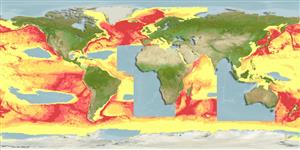
Antarctic, Arctic, Northeast Atlantic, the Mediterranean and Pacific Ocean. Temperate to polar.
Lunghezza alla prima maturità / Dimensione / Peso / Età
Maturità: Lm ? range ? - ? cm Max length : 30.0 cm TL maschio/sesso non determinato; (Fonte Biblio. 7882)
Simple, smooth body without any appendages aside from a short chaetae. Its head is short, triangular, and smooth. The species grow up to 15 cm made up of 150 segments, which is divided into two parts, the anterior that is relatively thick, cylindrical and purple or dark red, and the other is the tail region which is more slender and bright red or yellowish in color.
Species' maximum length from the Belgian part of the North Sea (Ref. 7882). Found in estuarine and inshore areas (Ref. 96352). Inhabits muddy bottoms (Refs. 2780, 7882, 96352). Pelagic larvae are present during December, February, and April, whereas settling has been observed in August to October. The settling larvae prefer mud, sand, and high salinities (Ref. 2778). Lives in a spiraled burrow (Ref. 7882). A subsurface deposit-feeder (Refs. 96292, 96352).
Ciclo vitale e comportamento di accoppiamento
Maturità | Riproduzione | Deposizione | Uova | Fecondità | Larve
Members of the class Polychaeta are mostly gonochoric (sexual). Mating: Females produce a pheromone attracting and signalling the males to shed sperm which in turn stimulates females to shed eggs, this behavior is known as swarming. Gametes are spawned through the metanephridia or body wall rupturing (termed as "epitoky", wherein a pelagic, reproductive individual, "epitoke", is formed from a benthic, nonreproductive individual, "atoke"). After fertilization, most eggs become planktonic; although some are retained in the worm tubes or burrowed in jelly masses attached to the tubes (egg brooders). Life Cycle: Eggs develop into trocophore larva, which later metamorph into juvenile stage (body lengthened), and later develop into adults.
López-Jamar, E., G. González and J. Mejuto 1986 Temporal changes of community structure and biomass in two subtidal macroinfaunal assemblages in La Coruña bay, NW Spain. Hydrobiologia 142:137-150. (Fonte Biblio. 2778)
Stato della Lista Rossa IUCN
(Fonte Biblio. 130435: Version 2025-2 (Global))
Stato della CITES (Fonte Biblio. 108899)
Not Evaluated
CMS (Fonte Biblio. 116361)
Not Evaluated
Minaccia per l'uomo
Usi umani
FAO - Publication: search | FishSource |
Strumenti
Informazioni ulteriori
Dinamica della popolazione Ciclo di vitaRiproduzioneMaturitàFeconditàDeposizioneUovaSviluppo delle uovaLarve FisiologiaConsumo di ossigeno
Legato all'uomoFrancobolli, monete, materiale vario.
Fonti Internet
Stime basate su modelli
Vulnerabilità della pesca
(Fonte Biblio. 71543) |
Low vulnerability (20 of 100). |
Categoria di prezzo
(Fonte Biblio. 80766): |
Unknown. |