-

- About this page
- Languages
-
Feedback
- Citation
- Upload
-
Related species
- Species in
Paracentrotus - Species in
Echinidae - - Classification -
- Echinidae
- Camarodonta
- Echinoidea
- Chordata
- Animalia
- Species in
-



Paracentrotus lividus (Lamarck, 1816)
Stony sea urchin| Native range | All suitable habitat | Point map | Year 2050 |

|
| This map was computer-generated and has not yet been reviewed. |
| Paracentrotus lividus AquaMaps Data sources: GBIF OBIS |
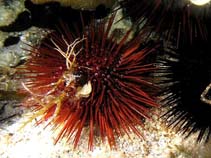
Classification / Names Common names | Synonyms | CoL | ITIS | WoRMS
Echinoidea | Camarodonta | Echinidae
Environment: milieu / climate zone / depth range / distribution range Ecology
Benthic; depth range 0 - 90 m (Ref. 85345). Tropical, preferred 17°C (Ref. 107945); 55°N - 21°N, 17°W - 36°E
Distribution Countries | FAO areas | Ecosystems | Occurrences | Introductions
Eastern Atlantic and the Mediterranean: from UK Scotland to West Sahara, and east to Lebanon. Subtropical and temperate.
Length at first maturity / Size / Weight / Age
Maturity: Lm ? range ? - ? cm Max length : 6.0 cm WD male/unsexed; (Ref. )
Feeds on marine plants and animal material (Ref. 113042).
Life cycle and mating behavior Maturity | Reproduction | Spawning | Eggs | Fecundity | Larvae
Members of the class Echinoidea are gonochoric. Fertilization is external. Brooding is common, eggs are held either on the peristome, around the periproct or deep into the concavities on the petaloids. Life cycle: Embryos develop into planktotrophic larvae (echinoplateus) and live for several months before they sink to the bottom using their tube feet to adhere on the ground where they metamorphose into young urchins.
Main reference
References | Coordinator | Collaborators
Koukouras, A. and M.-S. Kitsos 2010 Echinoderms. pp.288-296 In Coll, M., et al., 2010. The biodiversity of the Mediterranean Sea: estimates, patterns, and threats. PLoS ONE 5(8):36pp. (Ref. 85345)
IUCN Red List Status
(Ref. 130435: Version 2025-1)
CITES status (Ref. 108899)
Not Evaluated
CMS (Ref. 116361)
Not Evaluated
Threat to humans
Human uses
Fisheries: commercial
FAO - Aquaculture: production; Fisheries: landings | FishSource | Sea Around Us
Tools
More information
Trophic Ecology
Ecology
Population dynamics
Growth
Max. ages / sizes
Length-weight rel.
Length-length rel.
Length-frequencies
Mass conversion
Abundance
Max. ages / sizes
Length-weight rel.
Length-length rel.
Length-frequencies
Mass conversion
Abundance
Life cycle
Distribution
Physiology
Oxygen consumption
Human Related
Outreach
Taxonomy
References
Internet sources
BHL | BOLD Systems | CISTI | DiscoverLife | FAO(Fisheries: ; publication : search) | Fishipedia | GenBank (genome, nucleotide) | GloBI | Gomexsi | Google Books | Google Scholar | Google | PubMed | Tree of Life | Wikipedia (Go, Search) | Zoological Record
Estimates based on models
Preferred temperature
(Ref. 115969): 7.4 - 20.1, mean 11.8 (based on 600 cells).
Climate Vulnerability
(Ref. 125649):
Moderate to high vulnerability (51 of 100).
Nutrients : Calcium = 126 [75, 177] mg/100g; Iron = 5.08 [1.67, 7.92] mg/100g; Protein = 12%; Omega3 = 0.331 [0.263, 0.400] g/100g; Selenium = 0.04 [48.48, 67.17] μg/100g; VitaminA = 0 μg/100g; Zinc = 1.97 [0.92, 3.02] mg/100g (wet weight); based on nutrient studies.