Malacostraca |
Decapoda |
Xanthidae
Environnement : milieu / zone climatique / profondeur / gamme de distribution
Écologie
Récifal; profondeur 0 - 30 m (Réf. 128968), usually 0 - 10 m (Réf. 96667). Tropical
Indo-Pacific.
Longueur à la première maturité / Taille / Poids / Âge
Maturité: Lm ? range ? - ? cm
Description synthétique
Morphologie
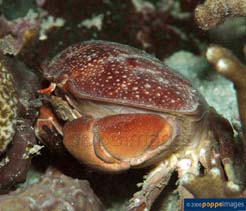
Carapace is broad and oval in shape with brownish-yellow color. Pincers have the same length while the legs are hardly pitted with fine hairs (Ref. 128968).
Usually found in rocky and sandy bottoms (Ref. 128968). Marginal levels of toxicity were detected in this species which may contribute to human poisoning (Ref. 107779). Intertidal to subtidal (Ref. 106854). Preys on tridacnids (Ref. 108392).
Cycle de vie et comportement reproducteur
Maturité | Reproduction | Frai | Œufs | Fécondité | Larves
Members of the order Decapoda are mostly gonochoric. Mating behavior: Precopulatory courtship ritual is common (through olfactory and tactile cues); usually indirect sperm transfer.
Tweedie, M.W.F. 1950 A collection of crabs from Aor Island, South China Sea. Bulletin of the Raffles Museum 21:83-96. (Réf. 81564)
Statut dans la liste rouge de l'IUCN
(Réf. 130435: Version 2025-2 (Global))
statut CITES (Réf. 108899)
Not Evaluated
Not Evaluated
Menace pour l'homme
Poisonous to eat (Réf. 107779)
Utilisations par l'homme
FAO - Publication: search | FishSource |
Outils
Plus d'informations
Dynamique des populationsCroissanceÂges / tailles maximalesLongueur-poids rel.Rel. longueur-longueur.Fréquences de longueursConversion de masseAbondance Cycle de vieReproductionMaturitéFéconditéFraiŒufsDéveloppement de l'œufLarves PhysiologieConsommation d'oxygène
Liées à l'hommeTimbres, pièces de monnaie, divers
Sources Internet
Estimations basées sur des modèles
Vulnérabilité de la pêche
(Réf. 71543) |
(0 of 100). |