Gastropoda |
Neogastropoda |
Muricidae
Entorno: milieu / zona climática / rango de profundidad / gama de distribución
Ecología
Benthic; salobre; rango de profundidad 10 - 60 m (Referencia 83435). Tropical; 4°C - 35°C (Referencia 88058); 41°N - 21°N, 112°E - 145°E
Northwest Pacific: Japan south to Hong Kong. Introduced in the Atlantic, the Mediterranean and Black Sea.
Longitud en la primera madurez / Tamaño / Peso / Edad
Madurez: Lm ? range ? - ? cm Max length : 16.1 cm SHH macho / no sexado; (Referencia 83435)
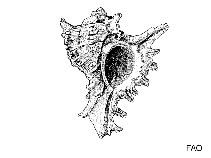
The species has a short-spired, heavy shell with a large inflated deep body whorl and deep umbilicus. The columella is broad, smooth, and slightly concave. Small and elongated teeth are present along the edge of the outer lip of the large ovate aperture. The external shell ornamentation has smooth spiral ribs that end in regular blunt knobs at both the shoulder and the periphery of the body whorl. In addition, fine spiral ridges are crossed by low vertical riblets. Body color is variable from gray to orange-brown and rarely blonde, with darker brown dashes on the spiral ribs. The aperture and columella vary from deep orange to yellow or off-white. Spiral, vein-like coloration, varying from black to dark blue, occasionally occurs internally, originating at the individual teeth at the outer lip of the aperture.
A large, predatory gastropod (Ref. 87893). The juvenile and adult stage of this species are preyed upon by loggerhead sea turtles (Caretta caretta) (Ref. 87893). Larvae are dispersed with water currents (Ref. 87977). This gastropod is a successful invader of marine coastal/brackish ecosystems , being tolerant to wide variations in temperature, salinity and oxygen concentration (Ref. 87992, 87996). Rapa whelks are generally encountered in areas to depths of 30 m in the Black Sea; on sandy bottoms at 15 m covered by Zostera sp. and Cymodocea nodosa meadows (Ref. 7956). Also occurs in rocky and muddy habitat (Ref. 87909). Feeds on bivalves (Ref. 87979).
Ciclo vital y comportamiento de apareamiento
Madurez | Reproducción | Puesta | Huevos | Fecundidad | Larva
This species is a non-broadcast spawner. Life cycle does not include trocophore stage. Also Ref. 833.
Tan, K.S. 2000 Species checklist of Muricidae (Mollusca: Gastropoda) in the South China Sea. The Raffles Bulletin of Zoology 8:495-512. (Referencia 81755)
Situación en la Lista Roja de la UICN
(Referencia 130435: Version 2025-2 (Global))
Estatus CITES (Referencia 108899)
Not Evaluated
CMS (Referencia 116361)
Not Evaluated
Amenaza para el ser humano
Harmless
Usos humanos
Pesquerías: comercial
FAO - Publication: search | FishSource | Sea Around Us
Herramientas
Más información
FisiologíaConsumo del oxígeno
Relacionados con el ser humanoSellos, monedas, varios
Fuentes de Internet
Estimaciones basadas en modelos
Rate of population increase
|
Prior r = 0.78, 95% CL = 0.51 - 1.17, Based on 1 full stock assessment. |
Vulnerabilidad pesquera
(Referencia 71543) |
Low vulnerability (10 of 100). |
Nutrients
|
Calcium = 126 [75, 177] mg/100g; Iron = 4.79 [1.67, 7.92] mg/100g; Protein = 15.9 [14.8, 16.9] %; Omega3 = 0.331 [0.263, 0.400] g/100g; Selenium = 57.8 [48.5, 67.2] μg/100g; VitaminA = 0 μg/100g; Zinc = 1.97 [0.92, 3.02] mg/100g (wet weight); based on nutrient studies. |