Hexacorallia |
Scleractinia |
Pocilloporidae
Milieu: milieu / Klimaatzone / Diepte / verspreidingsgebied
Ecologie
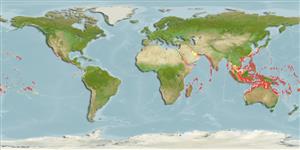
Rifbewoner; diepte 0 - 54 m (Ref. 269). Tropical; 36°N - 31°S, 32°E - 10°E (Ref. 847)
Indo-Pacific.
Lengte bij maturiteit / Grootte / Gewicht / Leeftijd
Maturiteit: Lm ? range ? - ? cm Max length : 30.0 cm WD mannelijk / geslacht onbekend; (Ref. 269)
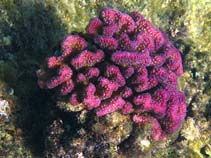
Colonies irregularly branching (ramose), less than 30 cm in diameter, covered with verrucae; corallites plocoid, about 0.1 cm across, found both on verrucae and in between. Stout branches usually more than 1 cm in diameter, but varies with exposure to water movement and depth. Colonies growing in shallow water or exposed to wave action tend to have thick sturdy branches while those from deep calm waters tend to have thinner branches. Color is mottled light brown in life and skeleton usually has reddish brown patches after cleaning (Ref. 269).
Maximum depth from Ref. 98471. It is found from fore-reefs (Ref. 87903) to protected fringing reefs and coral communities living on rocky substrates (Ref. 98471). Colonies growing in shallow water or exposed to wave action have thick sturdy branches while those from deep calm waters have thinner branches (Ref. 269).
Levenscyclus en paargedrag
Maturiteit | Voortplanting | Paaien | Eieren | Fecunditeit | Larven
Hermaphroditic (Ref. 113708). Mature gametes are shed into the coelenteron and spawned through the mouth. Life cycle: The zygote develops into a planktonic planula larva. Metamorphosis begins with early morphogenesis of tentacles, septa and pharynx before larval settlement on the aboral end (Ref. 833).
Hodgson, G. 1998 Corals. p. 101-122. In Carpenter, K.E. and V.H. Niem (eds) FAO species identifidication guide for fishery purposes. The living marine resources of the Western Central Pacific. Vol. 1. Seaweeds, coral, bivalves and gastropods. FAO Rome. (Ref. 269)
Status op de Rode Lijst van het IUCN
(Ref. 130435: Version 2025-2 (Global))
CITES status (Ref. 108899)
Not Evaluated
Gevaar voor de mens
Gebruik door de mens
FAO - Publication: search | FishSource |
Tools
Meer informatie
Trofische ecologieVoedsel (prooien)DieetsamenstellingVoedselconsumptiePredatoren LevenscyclusVoortplantingMaturiteitFecunditeitPaaienEierenOntwikkeling van de eierenLarven FysiologieZuurstofverbruik
Menselijk gerelateerdPostzegels, munten, diversen.
Internetbronnen
Schattingen op basis van modellen
Kwetsbaarheid van de visserij
(Ref. 71543) |
Low vulnerability (20 of 100). |
Prijsklasse
(Ref. 80766): |
Unknown. |