Not assigned |
Sipuncula |
Phascolosomatidae
Umwelt: Milieu / Klimazone / Tiefenbereich / Verbreitungsgebiet
Ökologie
Benthic; tiefenbereich 0 - 5 m (Ref. 1815). Temperate
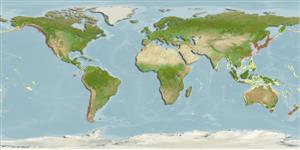
Indo-Pacific and the Mediterranean: Korean Peninsula.
Länge bei der ersten Reifung / Größe / Gewicht / Alter
Geschlechtsreife: Lm ? range ? - ? cm Max length : 4.0 cm TRKL Männchen/unbestimmt; (Ref. 1815)
Comparatively large animals of grayish yellow color. Body cylindrical. Trunk region 0.4 - 4 cm
long. Introvert almost as long as trunk region. Entire body surface densely set with large (0.06 - 0.08 cm) dome-shaped black papillae. Papillae especially numerous on terminal and anal shields. Cephalon bear-ing crown of 21-29 tentacles in horseshoe-like arrangement
around heart-shaped nuchal organ. Behind cephalon, introvert bearing specialized cuticular appendages (scalids), arranged into 15-30 circles. Two ventral and two dorsal retractors of introvert. Ventral retractors anchored in posterior third of trunk. Contractile vessel simple, with no lateral branches. Intestine with 10-18 loops, in dependence on animal size. Longitudinal
musculature of body wall divided into pronounced, isolated longitudinal bands. Spindle-shaped muscle fastened at terminal end of trunk; 1-3 fixing muscles. Anus located somewhat in front of or level with nephrophores. Wing muscles well-developed. Rectal diverticulum
absent. 2 nephridia fastened to body wall along 1/3 of their length via thin mesenterial filaments. Nephridiums 30 - 50 percentage as long as trunk (Ref. 1815).
Intertidal and subtidal on vegetation (Ref. 1815). Depth based on occurrence (Ref. 1815); to be replaced with better reference. Subtidal (Ref. 1815).
Lebenszyklus und Paarungsverhalten
Geschlechtsreife | Fortpflanzung | Ablaichen | Eier | Fruchtbarkeit | Larven
Morozov, T.B. and A.V. Adrianov 2002 Fauna of Sipunculans (Sipuncula) of Vostok Bay, Sea of Japan. Russian Journal of Marine Biology 28(6):365-370. (Ref. 1815)
IUCN Rote Liste Status
(Ref. 130435: Version 2025-2 (Global))
CITES Status (Ref. 108899)
Not Evaluated
Not Evaluated
Bedrohung für Menschen
Nutzung durch Menschen
FAO - Publication: search | FishSource |
Tools
Mehr Information
Trophische ÖkologieLebensmittel (Beutetiere)
Nahrungszusammensetzung
Nahrungsaufnahme
Räuber
PopulationsdynamikWachstum
Max. Alter/Größen
Länge-Gewicht-Rel.
Länge-Länge-Verhältnis.
Längenhäufigkeiten
Massenkonvertierung
Dichte
LebenszyklusFortpflanzungGeschlechtsreifeFruchtbarkeitAblaichenEierEientwicklungLarven PhysiologieSauerstoffverbrauch
MenschenbezogenBriefmarken, Münzen, Verschiedenes.
Internet Quellen
Schätzungen auf der Grundlage von Modellen
Anfälligkeit der Fischerei
(Ref. 71543) |
Low vulnerability (10 of 100). |
Preiskategorie
(Ref. 80766): |
Unknown. |