Florideophyceae |
Ceramiales |
Ceramiaceae
Environnement : milieu / zone climatique / profondeur / gamme de distribution
Écologie
Sessile. Tropical
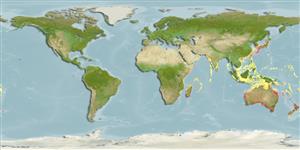
Indian Ocean: In India and Kwazulu-Natal, South Africa, east to Australia (Western Australia, Southern Australia and Victoria); Pacific Ocean: In Japan, Papua New Guinea south to Tasmania, including Lord Howe Island, east to Fiji.
Longueur à la première maturité / Taille / Poids / Âge
Maturité: Lm ? range ? - ? cm Max length : 25.0 cm TL mâle / non sexé; (Réf. 82093)
Description synthétique
Morphologie
Thalli are erect, to 25 cm high and pinnately branched up to 5 orders. A percurrent main axis is lacking.The holdfast is densely rhizoidal. Axes are corticated from close to the apices, with corticating filaments arising from the periaxial cells 5 to 10 cells proximal to the apex. Near the base the axes attain a width of 1.5 mm. Each axial cell bears a single lateral in a distichous-alternate pattern. Determinate branchlets are ecorticate, straight, 12-17 cells long and pinnately branched. Spinelike cells are absent. Indeterminate branchlets are formed irregularly and repeat the branching pattern of the main axes. Tetrahedrally divided tetrasporangia (40-52 μm in diameter) are borne laterally or terminally on the ultimate branchlets. Gametophytic plants were not observed (Ref. 82093).
Euptilota articulata has only been collected once in situ, at a depth of 35 m in southern Natal. The specimen in the Norris Herbarium (UN) was collected from the drift (Ref. 82093).
Cycle de vie et comportement reproducteur
Maturité | Reproduction | Frai | Œufs | Fécondité | Larves
Guiry, M.D. and G.M. Guiry 2009 AlgaeBase. World-wide electronic publication, National University of Ireland, Galway. http://www.algaebase.org; searched on 14 April 2009. (Réf. 80701)
Statut dans la liste rouge de l'IUCN
(Réf. 130435: Version 2025-2 (Global))
statut CITES (Réf. 108899)
Not Evaluated
Not Evaluated
Menace pour l'homme
Utilisations par l'homme
FAO - Publication: search | FishSource |
Outils
Plus d'informations
Écologie trophiqueAliments (proies)
Composition du régime alimentaire
Consommation alimentaire
Prédateurs
Dynamique des populationsCroissanceÂges / tailles maximalesLongueur-poids rel.Rel. longueur-longueur.Fréquences de longueursConversion de masseAbondance Cycle de vieReproductionMaturitéFéconditéFraiŒufsDéveloppement de l'œufLarves PhysiologieConsommation d'oxygène
Liées à l'hommeTimbres, pièces de monnaie, divers
Sources Internet
Estimations basées sur des modèles
Vulnérabilité de la pêche
(Réf. 71543) |
Low vulnerability (15 of 100). |