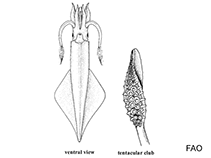
Cephalopoda |
Myopsida |
Loliginidae
Miljö: miljö / Klimatzon / djupintervall / distributionsområde
Ekologi
Bottenlevande; brackvatten; djupintervall 0 - 674 m (Ref. 104052), usually 20 - 200 m (Ref. 104052). Subtropical; 60°N - 21°N, 17°W - 36°E
Eastern Atlantic and the Mediterranean Sea.
Längd vid första mognad / Storlek / Vikt / Ålder
Könsmognad: Lm ? range ? - ? cm Max length : 8.8 cm ML hane/ej könsbestämd; (Ref. 104052); 13.2 cm ML (female)
Maximum depth range from Ref. 114857. Also found in brackish water. Demersal (Ref. 122892). Commonly found on the continental shelf and the upper slope (Ref. 104424), where it is the abundant in the former. Most common in water >150 m deep over sandy and muddy grounds. Undertakes seasonal migrations between offshore (in winter) and inshore (in spring) areas (Ref. 122892). Typically associated with the deep-sea gorgonacean coral Isidella elongata (Ref. 122886).
Livscykel och parningsbeteende
Könsmognad | Reproduktion | Lek | Ägg | Fekunditet | Larver
Members of the class Cephalopoda are gonochoric. Male and female adults usually die shortly after spawning and brooding, respectively. Mating behavior: Males perform various displays to attract potential females for copulation. During copulation, male grasp the female and inserts the hectocotylus into the female's mantle cavity where fertilization usually occurs. Life cycle: Embryos hatch into planktonic stage and live for some time before they grow larger and take up a benthic existence as adults.
Templado, J. and R. Villanueva 2010 Checklist of Phylum Mollusca. pp. 148-198 In Coll, M., et al., 2010. The biodiversity of the Mediterranean Sea: estimates, patterns, and threats. PLoS ONE 5(8):36pp. (Ref. 85339)
Status på IUCN:s rödlista
(Ref. 130435: Version 2025-2 (Global))
CITES-status (Ref. 108899)
Not Evaluated
Not Evaluated
Hot mot människor
Harmless
Mänskliga användningsområden
Fiskeri: kommersiell
FAO - Publication: search | FishSource |
Verktyg
Ytterligare information
LivscykelReproduktionKönsmognadFekunditetLekÄggUtveckling av äggLarver MänniskorelateradFrimärken, mynt, diverse.
Internet-källor
Uppskattningar baserade på modeller
Sårbarhet i fisket
(Ref. 71543) |
Low vulnerability (10 of 100). |