Malacostraca |
Decapoda |
Sergestidae
Milieu: milieu / Klimaatzone / Diepte / verspreidingsgebied
Ecologie
Benthopelagisch; brak water; diepte 0 - 55 m (Ref. 58807). Tropical; 27°N - 40°S, 76°E - 154°E
Indo-West Pacific: Africa to Australia (Ref. 374). Peréz Farfante formerly recognizes 3 subspecies: Acetes sibogae australis from the east coast of Australia, Acetes sibogae sibogae from Indo-West Pacific and Acetes sibogae sibogalis from India (Ref. 75620).
Lengte bij maturiteit / Grootte / Gewicht / Leeftijd
Maturiteit: Lm ? range ? - ? cm Max length : 4.0 cm BL mannelijk / geslacht onbekend; (Ref. 374)
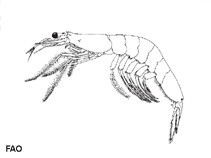
Rostrum, which has two dorsal denticles or teeth, is shorter than eyes. Elongated first 3 pereiopods and no fourth and fifth pereipods. Larger female than males. Color: in life, whole body almost transparent. Milky or yellowish when dead.
Minimum depth based on its ecology; to be replaced with a better reference. Inshore (Ref. 106568). Epibenthic (Ref. 122111). Epipelagic (Ref. 58807). Planktonic in life. Inhabits estuarine waters with mangroves (Ref. 374) where it is abundant (Ref. 122110). Found over muddy bottoms in estuarine and marine waters (Ref. 58807). Also found over sand and seagrass (Ref. 122110).
Levenscyclus en paargedrag
Maturiteit | Voortplanting | Paaien | Eieren | Fecunditeit | Larven
Members of the order Decapoda are mostly gonochoric. Mating behavior: Precopulatory courtship ritual is common (through olfactory and tactile cues); usually indirect sperm transfer.
Motoh, H. 1980 Field guide for the edible crustacea of the Philippines. Southeast Asian Fisheries Development Center (SEAFDEC). Aquaculture Department, Iloilo, Philippines. (Ref. 374)
Status op de Rode Lijst van het IUCN
(Ref. 130435: Version 2025-2 (Global))
CITES status (Ref. 108899)
Not Evaluated
Not Evaluated
Gevaar voor de mens
Gebruik door de mens
Visserij: commercieel
FAO - Publication: search | FishSource |
Tools
Meer informatie
Trofische ecologieVoedsel (prooien)DieetsamenstellingVoedselconsumptiePredatoren LevenscyclusVoortplantingMaturiteitFecunditeitPaaienEierenOntwikkeling van de eierenLarven FysiologieZuurstofverbruik
Menselijk gerelateerdPostzegels, munten, diversen.
Internetbronnen
Schattingen op basis van modellen
Kwetsbaarheid van de visserij
(Ref. 71543) |
Low vulnerability (10 of 100). |
Prijsklasse
(Ref. 80766): |
Very high. |