Hexacorallia |
Scleractinia |
Lobophylliidae
Umwelt: Milieu / Klimazone / Tiefenbereich / Verbreitungsgebiet
Ökologie
Riff-verbunden; tiefenbereich 0 - 30 m (Ref. 848). Tropical; 28°N - 31°S, 70°E - 180°E (Ref. 848)
Indo-West Pacific: Maldives, Indonesia to Melanesia, north to Taiwan and south to Australia.
Länge bei der ersten Reifung / Größe / Gewicht / Alter
Geschlechtsreife: Lm ? range ? - ? cm
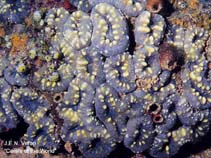
Formation: flat or hemispherical, phaceloid or partly flabello-meandroid; rarely exceeding 0.5 m across. Corallites: 40 to 50 mm in diameter, circular to irregular in outline. Primary septa: thick, with 3 to 5 long lobed teeth. Columellae: large, often diffuse. Poorly developed costae. Color: uniformly dark green or gray with yellowish primary septa (Ref. 848).
Occurs in protected upper reef slopes and lagoons (Ref. 848). Has high bleaching level and high estimated mortality in Palau (Ref. 66144).
Lebenszyklus und Paarungsverhalten
Geschlechtsreife | Fortpflanzung | Ablaichen | Eier | Fruchtbarkeit | Larven
Members of the class Anthozoa are either gonochoric or hermaphroditic. Mature gametes are shed into the coelenteron and spawned through the mouth. Life cycle: The zygote develops into a planktonic planula larva. Metamorphosis begins with early morphogenesis of tentacles, septa and pharynx before larval settlement on the aboral end.
Veron, J.E.N. and G. Hodgson 1989 Annotated checklist of the hermatypic corals of the Philippines. Pacific Science 43:234-287. (Ref. 8817)
IUCN Rote Liste Status
(Ref. 130435: Version 2025-2 (Global))
CITES Status (Ref. 108899)
Not Evaluated
Bedrohung für Menschen
Nutzung durch Menschen
FAO - Publication: search | FishSource |
Tools
Mehr Information
Trophische ÖkologieLebensmittel (Beutetiere)
Nahrungszusammensetzung
Nahrungsaufnahme
Räuber
PopulationsdynamikWachstum
Max. Alter/Größen
Länge-Gewicht-Rel.
Länge-Länge-Verhältnis.
Längenhäufigkeiten
Massenkonvertierung
Dichte
LebenszyklusFortpflanzungGeschlechtsreifeFruchtbarkeitAblaichenEierEientwicklungLarven PhysiologieSauerstoffverbrauch
MenschenbezogenBriefmarken, Münzen, Verschiedenes.
Internet Quellen
Schätzungen auf der Grundlage von Modellen
Anfälligkeit der Fischerei
(Ref. 71543) |
(0 of 100). |
Preiskategorie
(Ref. 80766): |
Unknown. |