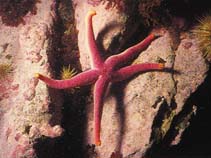
Asteroidea |
Spinulosida |
Echinasteridae
Milieu: milieu / Klimaatzone / Diepte / verspreidingsgebied
Ecologie
Benthic; diepte 0 - 2400 m (Ref. 865), usually 50 - 150 m (Ref. 125153). Temperate; 80°N - 40°N, 170°W - 45°E
Eastern Pacific, North Atlantic and the Arctic: North Sea and the Canadian Arctic Archipelago.
Lengte bij maturiteit / Grootte / Gewicht / Leeftijd
Maturiteit: Lm ? range ? - ? cm Max length : 15.0 cm WD mannelijk / geslacht onbekend; (Ref. 865)
It is found on rocks and soft bottoms in subtidal areas to a depth of 2,400 meters (Ref. 865). A carnivore; trophic level 3.1 (Ref. 96418). Feeds on at least 12 species of sponges and a common food item is Isodictya spp. (Ref. 96505). Occasionally relies on filter-feeding, specifically during summer and autmn. Opportunistic generalist predator (Ref. 130743).
Levenscyclus en paargedrag
Maturiteit | Voortplanting | Paaien | Eieren | Fecunditeit | Larven
The females brood their eggs (Ref. 865).
Jennings, S., J. Lancaster, A. Woolmer and J. Cotter 1999 Distribution, diversity and abundance of epibenthic fauna in the North Sea. Journal of the Marine Biological Association of the UK 79:385-399. (Ref. 3123)
Status op de Rode Lijst van het IUCN
(Ref. 130435: Version 2025-2 (Global))
CITES status (Ref. 108899)
Not Evaluated
Not Evaluated
Gevaar voor de mens
Gebruik door de mens
FAO - Publication: search | FishSource |
Tools
Meer informatie
LevenscyclusVoortplantingMaturiteitFecunditeitPaaienEierenOntwikkeling van de eierenLarven FysiologieZuurstofverbruik
Menselijk gerelateerdPostzegels, munten, diversen.
Internetbronnen
Schattingen op basis van modellen
Kwetsbaarheid van de visserij
(Ref. 71543) |
Low vulnerability (10 of 100). |
Prijsklasse
(Ref. 80766): |
Unknown. |