Pycnogonida |
Pantopoda |
Nymphonidae
Umwelt: Milieu / Klimazone / Tiefenbereich / Verbreitungsgebiet
Ökologie
Benthic; tiefenbereich 0 - 4136 m (Ref. 1680). Polar
Southeast Pacific, Western Atlantic, and Antarctic.
Länge bei der ersten Reifung / Größe / Gewicht / Alter
Geschlechtsreife: Lm ? range ? - ? cm
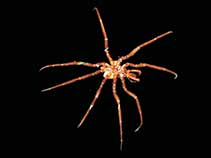
Leg span: 2 - 3 cm, a tall ocular tubercle with prominent eyes, and closely crowded lateral processes which usually, along with the trunk, have long dorsal spines. Spines are also carried on the chelifore scape and in rows along the leg. It has a short neck, crowded with a bulbous oviger base on each side. The male ovigers have distally inflated fifth and sixth segments which are often collapsed. The tarsus, with strong distal spines, is usually as long as or longer than the propodus which has a short main claw and vestigial or missing auxiliary claws. A wide range of variations occur among the many specimens of this species. This is attested to by its several synonyms. This is the genotype of a group of 20 predominantly Antarctic species which belong to a discrete assemblage called the australe group (Ref. 156). It shares the diagnostic characters enumerated above with the others and forms one of the groups into which this cumbersome genus must be divided if any sense is to be made of trying to separate its multitude of species (Ref. 9).
Maximum depth from Ref. 87394. Found to have hydroid colonies grasped in its chelifores (Ref. 121217).
Lebenszyklus und Paarungsverhalten
Geschlechtsreife | Fortpflanzung | Ablaichen | Eier | Fruchtbarkeit | Larven
Members of the class Pycnogonida are gonochoric and sexually dimorphic. During copulation, male usually suspends itself beneath the female. Fertilization occurs as the eggs leave the female's ovigers. Males brood the egg masses until they hatch. Life cycle: Eggs hatch into protonymphon larva then to adults.
Child, C.A. 1998 The marine fauna of New Zealand: Pycnogonida (sea spiders). NIWA Biodiversity Memoire 109. National Institute of Water and Atmospheric Research (NIWA). Washington, D.C. 20530, USA. 71 p. + Figure 2A-G, 3A-F, 4, 5. (Ref. 9)
IUCN Rote Liste Status
(Ref. 130435: Version 2025-2 (Global))
CITES Status (Ref. 108899)
Not Evaluated
Not Evaluated
Bedrohung für Menschen
Nutzung durch Menschen
FAO - Publication: search | FishSource |
Tools
Mehr Information
Trophische ÖkologieLebensmittel (Beutetiere)
Nahrungszusammensetzung
Nahrungsaufnahme
Räuber
PopulationsdynamikWachstum
Max. Alter/Größen
Länge-Gewicht-Rel.
Länge-Länge-Verhältnis.
Längenhäufigkeiten
Massenkonvertierung
Dichte
LebenszyklusFortpflanzungGeschlechtsreifeFruchtbarkeitAblaichenEierEientwicklungLarven PhysiologieSauerstoffverbrauch
MenschenbezogenBriefmarken, Münzen, Verschiedenes.
Internet Quellen
Schätzungen auf der Grundlage von Modellen
Anfälligkeit der Fischerei
(Ref. 71543) |
(0 of 100). |
Preiskategorie
(Ref. 80766): |
Unknown. |