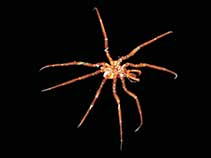
Pycnogonida |
Pantopoda |
Nymphonidae
สิ่งแวดล้อม : สิ่งแวดล้อม / เขตภูมิอากาศ / ระดับความลึก / ระยะการกระจายสินค้า
นิเวศวิทยา
Benthic; ระดับความลึก 0 - 4136 m (อ้างอิง 1680). Polar
Southeast Pacific, Western Atlantic, and Antarctic.
ความยาวเมื่อครบกำหนดครั้งแรก / ขนาด / น้ำหนัก / อายุ
วัยเจริญพันธุ์: Lm ? range ? - ? cm
Leg span: 2 - 3 cm, a tall ocular tubercle with prominent eyes, and closely crowded lateral processes which usually, along with the trunk, have long dorsal spines. Spines are also carried on the chelifore scape and in rows along the leg. It has a short neck, crowded with a bulbous oviger base on each side. The male ovigers have distally inflated fifth and sixth segments which are often collapsed. The tarsus, with strong distal spines, is usually as long as or longer than the propodus which has a short main claw and vestigial or missing auxiliary claws. A wide range of variations occur among the many specimens of this species. This is attested to by its several synonyms. This is the genotype of a group of 20 predominantly Antarctic species which belong to a discrete assemblage called the australe group (Ref. 156). It shares the diagnostic characters enumerated above with the others and forms one of the groups into which this cumbersome genus must be divided if any sense is to be made of trying to separate its multitude of species (Ref. 9).
Maximum depth from Ref. 87394. Found to have hydroid colonies grasped in its chelifores (Ref. 121217).
วงจรชีวิตและพฤติกรรมการผสมพันธุ์
วัยเจริญพันธุ์ | การสืบพันธุ์ | การวางไข่ | เซลสืบพันธ์ของเพศเมีย(ไข่) | ความดกของไข่ | ตัวอ่อน
Members of the class Pycnogonida are gonochoric and sexually dimorphic. During copulation, male usually suspends itself beneath the female. Fertilization occurs as the eggs leave the female's ovigers. Males brood the egg masses until they hatch. Life cycle: Eggs hatch into protonymphon larva then to adults.
Child, C.A. 1998 The marine fauna of New Zealand: Pycnogonida (sea spiders). NIWA Biodiversity Memoire 109. National Institute of Water and Atmospheric Research (NIWA). Washington, D.C. 20530, USA. 71 p. + Figure 2A-G, 3A-F, 4, 5. (อ้างอิง 9)
สถานะบัญชีแดงของ IUCN
(อ้างอิง 130435: Version 2025-2 (Global))
สถานะไซเตส (อ้างอิง 108899)
Not Evaluated
CMS (อ้างอิง 116361)
Not Evaluated
ภัยคุกคามต่อมนุษย์
การใช้ของมนุษย์
FAO - Publication: search | FishSource |
เครื่องมือ
ข้อมูลเพิ่มเติม
นิเวศวิทยาเขตร้อนรายการอาหาร (เหยื่อ)
องค์ประอบของอาหาร
การบริโภคอาหาร
ผู้ล่า
พลวัตของประชากรการเจริญเติบโต
อายุสูงสุด / ขนาด
ความยาว-น้ำหนักสัมพันธ์
ความยาว-ความยาวสัมพันธ์
ความยาว-ความถี่
การแปลงมวล
อุดมสมบรูณ์
วงจรชีวิตการสืบพันธุ์วัยเจริญพันธุ์ความดกของไข่การวางไข่เซลสืบพันธ์ของเพศเมีย(ไข่)การพัฒนาไข่ตัวอ่อน เกี่ยวข้องกับมนุษย์แสตมป์ เหรียญ อื่นๆ
แหล่งที่มาจากอินเตอร์เน็ต
การประมาณค่าตามแบบจำลอง
ความเสี่ยงต่อการตกปลา
(อ้างอิง 71543) |
(0 of 100). |
หมวดหมู่ราคา
(อ้างอิง 80766): |
Unknown. |