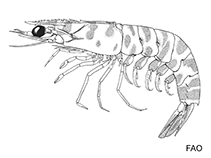
Malacostraca |
Decapoda |
Penaeidae
Environment: milieu / climate zone / depth range / distribution range
Ecology
Benthic; brackish; depth range 0 - 45 m (Ref. 8), usually 45 - 45 m (Ref. 8). Tropical, preferred 25°C (Ref. 107945); 33°N - 4°S, 118°W - 77°W
Eastern Pacific: Baja California, Mexico to Tumbes, Peru. Introduced in the eastern Indian Ocean, north and west Pacific, and western Atlantic.
Length at first maturity / Size / Weight / Age
Maturity: Lm ?, range 17 - ? cm Max length : 23.0 cm TL male/unsexed; (Ref. 8)
Maximum carapace length: 5.9 cm (Ref. 8). Occurs at depths from 0 to 27m, rarely at 45 m, in bottom mud and clay or sandy mud marine (adults) and estuarine (juveniles) environment. Subtropical to tropical climates (Ref. 8).
Mating behavior: Precopulatory courtship ritual is common (through olfactory and tactile cues); usually indirect sperm transfer (Ref. 833).
Holthuis, L.B. 1980 FAO Species Catalogue. Vol. 1. Shrimps and prawns of the world. An annotated catalogue of species of interest to fisheries. FAO Fish. Synop. 125(1):271 p. Rome: FAO. (Ref. 8)
IUCN Red List Status
(Ref. 130435: Version 2025-2 (Global))
CITES status (Ref. 108899)
Not Evaluated
Not Evaluated
Threat to humans
Human uses
Fisheries: commercial
FAO - Aquaculture Systems: production searchFisheries: species profile, landings search; Publication: search | FishSource | Sea Around Us
Tools
More information
Trophic EcologyFood items (preys)
Diet composition
Food consumption
Predators
PhysiologyOxygen consumption
Human RelatedStamps, coins, misc.
Internet sources
Estimates based on models
Resilience
(Ref. 69278): |
High, minimum population doubling time less than 15 months (K=1.29-2.28) |
Rate of population increase
|
Prior r = 1.11, 95% CL = 0.73 - 1.67, Based on 4 data-limited stock assessments. |
Fishing Vulnerability
(Ref. 71543) |
Low vulnerability (12 of 100). |
Climate Vulnerability
(Ref. 125649) |
Moderate vulnerability (40 of 100) |
Price category
(Ref. 80766): |
Very high. |
Nutrients
|
Calcium = 109 [35, 184] mg/100g; Iron = 1.59 [1.21, 1.97] mg/100g; Protein = 20.2 [19.2, 21.3] %; Omega3 = 0.285 [0.185, 0.386] g/100g; Selenium = 48.3 [-31.7, 128.3] μg/100g; VitaminA = 0 μg/100g; Zinc = 1.79 [1.17, 2.40] mg/100g (wet weight); based on nutrient studies. |