Holothuroidea |
Holothuriida |
Holothuriidae
Milieu: milieu / Klimaatzone / Diepte / verspreidingsgebied
Ecologie
Rifbewoner; diepte 0 - 40 m (Ref. 122), usually 15 - 30 m (Ref. 98471). Tropical; 30°N - 27°S, 32°E - 138°W (Ref. 106969)
Indo-Pacific.
Lengte bij maturiteit / Grootte / Gewicht / Leeftijd
Maturiteit: Lm ?, range 32 - ? cm Max length : 57.0 cm TL mannelijk / geslacht onbekend; (Ref. 122); common length : 42.0 cm TL mannelijk / geslacht onbekend; (Ref. 122); max. gepubliceerd gewicht: 4.0 kg (Ref. 122)
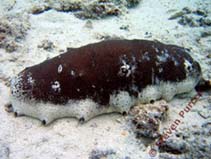
Mean live wt. 2,400 - 4000 g; body-wall thickness: 1.2 cm. Body: sub oval, stout, firm and rigid, arched dorsally (bivium) and flattened ventrally (trivium). Bivium with characteristic large lateral papillae (teats) and often covered by sand. Bivium with small papillae as well as podia ending in a disc of around 0.045 cm diameter; podia on trivium stout, arranged irregularly, their calcareous disc around 0.06 cm in diameter. Mouth ventral, surrounded by a collar of long yellowish papillae and 20 grey, stout tentacles. Anus surrounded by 5 stout calcareous teeth. Calcareous ring with large radial pieces (slightly different from Holothuria nobilis). Cuvierian tubules absent. Color variable; bivium brown with more or less distinct whitish spots, becoming larger on sides; trivium lighter, generally whitish. Spicules in form of tables and buttons; dorsal and ventral tegument with 2 kinds of tables; one form of table having an undulated disc with 10 to 15 irregular holes, supporting a massive spire with 4 pillars, ending in a very large , spiny, perforated crown; the other form of table, more frequent in the dorsal tegument, have a larger disc, with more holes and a spire ending in a crown composed of 2 or 3 rows of stout spines and 5 or 6 spiny pillars; ventral tegument buttons simple, with 8 holes or more complicated as fenestrated ellipsoids; dorsal-tegument buttons only as fenestrated ellipsoids; ventral and dorsal podia with large plates, multiperforated; tentacles with spiny ending rods up to 0.07 cm.
Harvested in artisanal fisheries throughout the tropical Indo-Pacific, in places where its habitat occurs. Collected by skin diving or using diving gear (if not banned), making the populations vulnerable due to overexploitation. The processed product is of major commercial value and very highly demanded at present, even though the stocks have declined within the tropical Indo-Pacific. Populations do not reach densities as high as Holothuria nobilis, with medium densities around 0.001 per square meter. With deeper distribution than Holothuria nobilis (Ref. 122). Minimum depth from Ref. 98471. Generally occurs on outer barrier reefs and passes (Ref. 122), and fore reef slopes (Ref. 85218), but also known to inhabit shallow seagrass beds (Ref. 122). Also in slightly deeper waters. Common on coral slabs near reef passages or at the foot of reef slopes (Ref. 118) and lagoons over sandy bottoms (Ref. 102863). Juveniles are found to inhabit intertidal area heavily covered in algae. They are also observed in seagrass beds on a fringing reef flat (Ref. 104206). Appears to recruit to shallow seagrass beds, then migrates to deeper waters such as island gaps and moves to deeper waters of the lagoon floor as it sexually matures (Ref. 709). Deposit feeder (Ref. 833).
Sexual reproduction takes place during the warm season. A species with a low potential fecundity and late sexual maturity.
Conand, C. 1998 Holothurians (sea cucumbers, Class Holothuroidea). p. 1157-1190. In Carpenter, K.E. and V.H. Niem (eds.) FAO Species Identification Guide for Fishery Purposes. The Living Marine Resources of the Western Central Pacific. Vol. 2. Cephalopods, crustaceans, holothurians and sharks. FAO Rome. (Ref. 122)
Status op de Rode Lijst van het IUCN
(Ref. 130435: Version 2025-2 (Global))
CITES status (Ref. 108899)
Not Evaluated
Gevaar voor de mens
Harmless
Gebruik door de mens
Visserij: van groot commercieel belang
FAO - visserij: landings search; Publication: search | FishSource |
Tools
Meer informatie
Trofische ecologieVoedsel (prooien)
Dieetsamenstelling
Voedselconsumptie
Predatoren
FysiologieZuurstofverbruik
Menselijk gerelateerdPostzegels, munten, diversen.
Internetbronnen
Schattingen op basis van modellen
Weerstandsvermogen
(Ref. 69278): |
Hoog, minimale populatieverdubbelingstijd minder dan 15 maanden (K=0.5) |
Kwetsbaarheid van de visserij
(Ref. 71543) |
High vulnerability (60 of 100). |
Prijsklasse
(Ref. 80766): |
Unknown. |