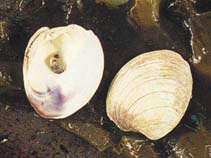
Bivalvia |
Venerida |
Mactridae
Environnement : milieu / zone climatique / profondeur / gamme de distribution
Écologie
Benthic; profondeur 0 - 70 m (Réf. 83435). Temperate; 16°C - 22°C (Réf. 138592), preferred 10°C (Réf. 107945); 49°N - 30°N, 82°W - 56°W
Western Atlantic Ocean: from Georgia, USA to Florida, east to St. Pierre Miquelon and north to Gaspé Bay, Quebec.
Longueur à la première maturité / Taille / Poids / Âge
Maturité: Lm ?, range 5 - 8.5 cm Max length : 20.0 cm SHL mâle / non sexé; (Réf. 7726); âge max. reporté: 31 années (Réf. 8702)
Inhabits the shallow continental shelf (Ref. 106944) on compact and stable fine sand (Ref. 138590). Suspension feeder (Ref. 78574).
Cycle de vie et comportement reproducteur
Maturité | Reproduction | Frai | Œufs | Fécondité | Larves
Members of the class Bivalvia are mostly gonochoric, some are protandric hermaphrodites. Life cycle: Embryos develop into free-swimming trocophore larvae, succeeded by the bivalve veliger, resembling a miniature clam.
Harvey-Clark, C. 1997 Eastern tidepool and reef: north-central Atlantic marinelife guide. Hancock House Publishers, 64pp. (Réf. 7726)
Statut dans la liste rouge de l'IUCN
(Réf. 130435: Version 2025-2 (Global))
statut CITES (Réf. 108899)
Not Evaluated
Not Evaluated
Menace pour l'homme
Utilisations par l'homme
Pêcheries: commercial
FAO - pêcheries: Résumé espèce, landings search; Publication: search | FishSource | Sea Around Us
Outils
Plus d'informations
Écologie trophiqueAliments (proies)
Composition du régime alimentaire
Consommation alimentaire
Prédateurs
Dynamique des populations PhysiologieConsommation d'oxygène
Liées à l'hommeTimbres, pièces de monnaie, divers
Sources Internet
Estimations basées sur des modèles
Résilience
(Ref. 69278): |
Milieu, temps minimum de doublement de population : 1,4 à 4,4 années (K=0.23-0.36; tm=2; tmax=31) |
Rate of population increase
|
Prior r = 0.53, 95% CL = 0.35 - 0.80, Based on 1 full stock assessment. |
Vulnérabilité de la pêche
(Réf. 71543) |
Moderate to high vulnerability (50 of 100). |
Vulnérabilité climatique
(Réf. 125649) |
High vulnerability (60 of 100) |
Catégorie de prix
(Réf. 80766): |
Low. |
Nutrients
|
Calcium = 149 [71, 228] mg/100g; Iron = 8.53 [1.95, 15.11] mg/100g; Protein = 9.88 [8.64, 11.12] %; Omega3 = 0.313 [0.202, 0.423] g/100g; Selenium = 61 [50, 72] μg/100g; VitaminA = 0 μg/100g; Zinc = 2.04 [0.56, 3.51] mg/100g (wet weight); based on nutrient studies. |