Gastropoda |
Cycloneritida |
Neritidae
Environnement : milieu / zone climatique / profondeur / gamme de distribution
Écologie
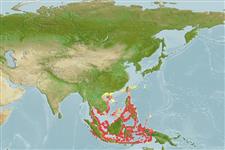
Benthic. Tropical; 26°N - 9°S, 99°E - 136°E
Western Pacific.
Longueur à la première maturité / Taille / Poids / Âge
Maturité: Lm ? range ? - ? cm Max length : 4.0 cm ShL mâle / non sexé; (Réf. 821)
Description synthétique
Morphologie
Shell ovate and thick, flatly excavated at the base. Spire small, whorls narrowly rounded with spiral ribs separated by grooves. Columella widely concave, granulated and toothed. Colouration: ribs blue-black, marked with white lines, grooves whitish, spotted with blue black (Ref. 128042).
Collected by gleaning for its edible flesh (Ref. 128042). Length based on occurrence data; to be replaced with better reference. Abundant in rocky shores, forming dense colonies in upper mid-tidal pools, on wet submerged rocks and in crevices. Also found in intertidal areas (Ref. 128042).
Cycle de vie et comportement reproducteur
Maturité | Reproduction | Frai | Œufs | Fécondité | Larves
Members of the order Neritopsina are mostly gonochoric and broadcast spawners. Life cycle: Embryos develop into planktonic trocophore larvae and later into juvenile veligers before becoming fully grown adults.
Springsteen, F.J. and F.M. Leobrera 1986 Shells of the Philippines. Carfel Seashell Museum. Metro Manila, Philippines. 377 p. (Réf. 821)
Statut dans la liste rouge de l'IUCN
(Réf. 130435: Version 2025-2 (Global))
statut CITES (Réf. 108899)
Not Evaluated
Not Evaluated
Menace pour l'homme
Utilisations par l'homme
FAO - Publication: search | FishSource |
Outils
Plus d'informations
Écologie trophiqueAliments (proies)
Composition du régime alimentaire
Consommation alimentaire
Prédateurs
Dynamique des populationsCroissanceÂges / tailles maximalesLongueur-poids rel.Rel. longueur-longueur.Fréquences de longueursConversion de masseAbondance Cycle de vieReproductionMaturitéFéconditéFraiŒufsDéveloppement de l'œufLarves PhysiologieConsommation d'oxygène
Liées à l'hommeTimbres, pièces de monnaie, divers
Sources Internet
Estimations basées sur des modèles
Vulnérabilité de la pêche
(Réf. 71543) |
Low vulnerability (10 of 100). |