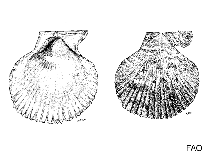
Bivalvia |
Pectinida |
Pectinidae
Environnement : milieu / zone climatique / profondeur / gamme de distribution
Écologie
Benthic; profondeur 0 - 82 m (Réf. 89006). Tropical
Atlantic, Indian, and Pacific Ocean.
Longueur à la première maturité / Taille / Poids / Âge
Maturité: Lm ? range ? - ? cm
Dead specimens washed up on beaches, and to 30 m (Ref. 377). Occurs on soft sediments, coral rubble, sand, rocky shores, and tidal pools at intertidal depths. Also on slabs of coral limestone and scattered reefs (Ref. 87907). Living at depths intertidally to 24 m (Ref. 89006). Single valves found on the beaches (Ref. 88739).
Cycle de vie et comportement reproducteur
Maturité | Reproduction | Frai | Œufs | Fécondité | Larves
Members of the class Bivalvia are mostly gonochoric, some are protandric hermaphrodites. Life cycle: Embryos develop into free-swimming trocophore larvae, succeeded by the bivalve veliger, resembling a miniature clam.
Werner, T.B. and G.R. Allen 2000 A rapid marine biodiversity assessment of the Calamianes Islands, Palawan province, Philippines. RAP Bulletin of Biological Assessment 17. Washington, D.C.:Conservation International. (Réf. 8295)
Statut dans la liste rouge de l'IUCN
(Réf. 130435: Version 2025-2 (Global))
statut CITES (Réf. 108899)
Not Evaluated
Not Evaluated
Menace pour l'homme
Harmless
Utilisations par l'homme
FAO - Publication: search | FishSource |
Outils
Plus d'informations
Écologie trophiqueAliments (proies)
Composition du régime alimentaire
Consommation alimentaire
Prédateurs
Dynamique des populationsCroissance
Âges / tailles maximales
Longueur-poids rel.
Rel. longueur-longueur.
Fréquences de longueurs
Conversion de masse
Abondance
Cycle de vieReproductionMaturitéFéconditéFraiŒufsDéveloppement de l'œufLarves PhysiologieConsommation d'oxygène
Liées à l'hommeTimbres, pièces de monnaie, divers
Sources Internet
Estimations basées sur des modèles
Vulnérabilité de la pêche
(Réf. 71543) |
(0 of 100). |