Phaeophyceae |
Fucales |
Sargassaceae
Umwelt: Milieu / Klimazone / Tiefenbereich / Verbreitungsgebiet
Ökologie
Sessile; tiefenbereich 0 - 53 m (Ref. 102117). Tropical
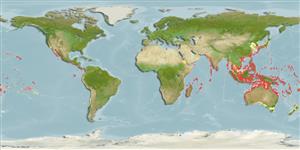
Indo-Pacific: from Eritrea to South Africa to Madagascar and India, including Western Australia, Andaman, Nicobar and Christmas Islands and from China to the South China Sea, Australia, including Federated States of Micronesia, Fiji, and French Polynesia; from east to Chile, including American Samoa, Samoan Archipelago, Cook and Hawaiian Islands.
Länge bei der ersten Reifung / Größe / Gewicht / Alter
Geschlechtsreife: Lm ? range ? - ? cm
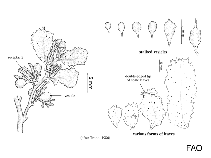
Thalli erect and tough, dark brown, attached to rocky substrate by coarse branched holdfasts. Alternating turbinate, fleshy leaves with a terete stalk, crowded along the erect axis; distal end of leaves expanded to form a somewhat circular and fleshy marginal blade, outlined by sharp and coarse teeth; centre of blade concave and conspicuously surrounded, partially or fully, by a crown of teeth; single vesicles may be found at the depressed centre, usually among the leaves at the upper portion of the thallus. Receptacular branches racemose, 5 to 7 mm long, attached to the stalk of the leaves, about 1/3 the distance from the base, their distal portions irregularly forked. Thalli up to 17 cm in height (Ref. 80758).
Used for human consumption, as insect repellant and fertilizer; source of algin, tannins and
phenols (Ref. 80758). Thrives mostly on rocky reef areas exposed to strong water turbulence, also on coralline rocks in calmer waters, commonly partially exposed during very low tides (Ref. 80758).
Lebenszyklus und Paarungsverhalten
Geschlechtsreife | Fortpflanzung | Ablaichen | Eier | Fruchtbarkeit | Larven
Guiry, M.D. and G.M. Guiry 2009 AlgaeBase. World-wide electronic publication, National University of Ireland, Galway. http://www.algaebase.org; searched on 14 April 2009. (Ref. 80701)
IUCN Rote Liste Status
(Ref. 130435: Version 2025-2 (Global))
CITES Status (Ref. 108899)
Not Evaluated
Not Evaluated
Bedrohung für Menschen
Nutzung durch Menschen
Fischereien: kommerziell
FAO - Publication: search | FishSource |
Tools
Mehr Information
Trophische ÖkologieLebensmittel (Beutetiere)
Nahrungszusammensetzung
Nahrungsaufnahme
Räuber
PopulationsdynamikWachstumMax. Alter/GrößenLänge-Gewicht-Rel.Länge-Länge-Verhältnis.LängenhäufigkeitenMassenkonvertierungDichte LebenszyklusFortpflanzungGeschlechtsreifeFruchtbarkeitAblaichenEierEientwicklungLarven PhysiologieSauerstoffverbrauch
MenschenbezogenBriefmarken, Münzen, Verschiedenes.
Internet Quellen
Schätzungen auf der Grundlage von Modellen
Anfälligkeit der Fischerei
(Ref. 71543) |
(0 of 100). |