Phaeophyceae |
Fucales |
Sargassaceae
Environnement : milieu / zone climatique / profondeur / gamme de distribution
Écologie
Sessile. Tropical
Atlantic and Indo-Pacific oceans.
Longueur à la première maturité / Taille / Poids / Âge
Maturité: Lm ? range ? - ? cm
Description synthétique
Morphologie
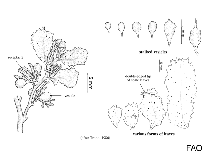
Holdfast shield-shaped to discoid, massive in some where 2 or more thalli arise from a fused holdfast; stem up to 25 mm long, cylindrical, warty. Primary branches terete, smooth. Secondary branches terete, alternately attached irregularly on the primary branch, smooth. Leaves of secondary branches of vegetative thallus mainly ovate-lanceolate to oblong to linear-lanceolate; base unequal; margin generally serrate, entire in some; apex generally obtuse to acute; midrib distinct but disappearing near apex; cryptostomata numerous and scattered. Leaves in fertile materials mainly linear to linear-lanceolate, some linear-oblanceolate, up to 40 mm long and 4 to 5 mm wide; base acute, slightly unequal; margin dentate-serrate, entire in some; apex narrowly acute; midrib distinct. Cryptostomata sparse
in leaves of primary laterals, sparse and scattered in leaves of secondary laterals, but distinct and with tendency to be arranged in rows in narrow leaves of terminal branches. Vesicles numerous, spherical or obovate, blunt; base plain or ear-like or with narrow extended margin; mainly small in fertile materials; racemose; vesicles 1 to 2 mm long, with very short stalks, 1 or less than 1 mm long. Plant dioecious. Male receptacles racemose, up to 15 mm long, pinched in here and there, 0.3 to 0.5 mm in diameter (in dried material) with blunt tip. Female receptacles racemose; receptacular branches compressed to triquetrous, with edges or margins finely serrate to dentate, up to 6 mm or sometimes longer, sometimes slightly twisted. Primary branches up to 80 cm (rarely to 175 cm) in length (Ref. 80758).
Used for human consumption mainly as emulsifying, stabilizing and gelling agents in food products such as frozen food, pastries, desserts, jellies, salad dressings, ice creams, meat and flavor sauces, beer, fruit juices, and milk shakes; contains iodine, protein, vitamin C, and minerals like Ca, K, Mg, Na, Cu, Zn, S, P, Mn); used as medicine: for goiter, glandular troubles, antibacterial, antitumor; source of tannins and phenols; also used for animal feed and fertilizer (Ref. 80758). Found on coralline substrate in the low intertidal zone, exposed to air only during extremely low tides (Ref. 80758).
Cycle de vie et comportement reproducteur
Maturité | Reproduction | Frai | Œufs | Fécondité | Larves
Guiry, M.D. and G.M. Guiry 2009 AlgaeBase. World-wide electronic publication, National University of Ireland, Galway. http://www.algaebase.org; searched on 14 April 2009. (Réf. 80701)
Statut dans la liste rouge de l'IUCN
(Réf. 130435: Version 2025-2 (Global))
statut CITES (Réf. 108899)
Not Evaluated
Not Evaluated
Menace pour l'homme
Utilisations par l'homme
Pêcheries: commercial
FAO - Publication: search | FishSource |
Outils
Plus d'informations
Écologie trophiqueAliments (proies)
Composition du régime alimentaire
Consommation alimentaire
Prédateurs
Dynamique des populationsCroissance
Âges / tailles maximales
Longueur-poids rel.
Rel. longueur-longueur.
Fréquences de longueurs
Conversion de masse
Abondance
Cycle de vieReproductionMaturitéFéconditéFraiŒufsDéveloppement de l'œufLarves PhysiologieConsommation d'oxygène
Liées à l'hommeTimbres, pièces de monnaie, divers
Sources Internet
Estimations basées sur des modèles
Vulnérabilité de la pêche
(Réf. 71543) |
(0 of 100). |