Phaeophyceae |
Dictyotales |
Dictyotaceae
Environnement : milieu / zone climatique / profondeur / gamme de distribution
Écologie
Epiphytic; profondeur 0 - 55 m (Réf. 80758). Subtropical
Indo-Pacific, Atlantic Ocean and the Mediterranean.
Longueur à la première maturité / Taille / Poids / Âge
Maturité: Lm ? range ? - ? cm
Description synthétique
Morphologie
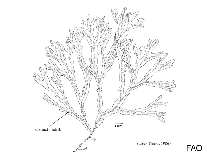
Thalli erect, light to dark brown, attached to the substrate by a small discoid holdfast. Branching regularly dichotomous, forming angles of 15° to 35°. Branches strap-shaped, 3 to 6
mm wide, broadest below each fork. Apices of terminal segments emarginate. Blade margin entire with occasional short stubby spines. Cross-section of a branch shows 3 layers of cells, consisting of a middle layer of large, rectangular cells, and bounded on the upper and lower surfaces by a layer of small, cuboidal and pigmented cortical cells. Thalli up to 14 cm in height (Ref. 80758).
A good source of alginate, an emulsifying, stabilizing and gelling agent in several food products such as frozen food, pastries, jellies, salad dressings, ice cream, meat and flavor sauces, beer, fruit juices, and milk shakes (Ref. 80758). Grows abundantly in shallow waters throughout the year; also found on rocks below the low tide mark at calm open coasts and sheltered coasts though some have been reported from a depth of 55 m (Ref. 80758).
Cycle de vie et comportement reproducteur
Maturité | Reproduction | Frai | Œufs | Fécondité | Larves
Guiry, M.D. and G.M. Guiry 2009 AlgaeBase. World-wide electronic publication, National University of Ireland, Galway. http://www.algaebase.org; searched on 14 April 2009. (Réf. 80701)
Statut dans la liste rouge de l'IUCN
(Réf. 130435: Version 2025-2 (Global))
statut CITES (Réf. 108899)
Not Evaluated
Not Evaluated
Menace pour l'homme
Utilisations par l'homme
FAO - Publication: search | FishSource |
Outils
Plus d'informations
Écologie trophiqueAliments (proies)
Composition du régime alimentaire
Consommation alimentaire
Prédateurs
Dynamique des populationsCroissanceÂges / tailles maximalesLongueur-poids rel.Rel. longueur-longueur.Fréquences de longueursConversion de masseAbondance Cycle de vieReproductionMaturitéFéconditéFraiŒufsDéveloppement de l'œufLarves PhysiologieConsommation d'oxygène
Liées à l'hommeTimbres, pièces de monnaie, divers
Sources Internet
Estimations basées sur des modèles
Vulnérabilité de la pêche
(Réf. 71543) |
(0 of 100). |