Ulvophyceae |
Bryopsidales |
Caulerpaceae
Umwelt: Milieu / Klimazone / Tiefenbereich / Verbreitungsgebiet
Ökologie
Sessile; brackwasser; tiefenbereich 0 - 50 m (Ref. 83908). Tropical
Indo-Pacific, Atlantic Ocean and the Mediterranean.
Länge bei der ersten Reifung / Größe / Gewicht / Alter
Geschlechtsreife: Lm ? range ? - ? cm
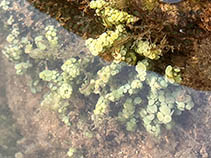
A highly variable species. The typical variety is characterized by short erect branches bearing crowded ramuli with short stalks and oval or spherical tips. The arrangement and shape of the ramuli differ among the numerous varieties.The ramuli can be sparse or dense, arranged radially, alternately, pinnately or irregular on the erect branch. The distal portion of the ramuli can be clavate, turbinate, globose truncate, or sometimes discoid. Plants growing on sandy substrate in calm, turbid water of the reef flat tend to have long erect branches densely covered with clavate or capitate ramuli while those growing on rocky-wave exposed portions of the reef possess strong short erect branches which bear crowded ramuli with spherical or globose tips. Erect branches up to 10 cm in height (Ref. 80758).
Used for human consumption and medicine: antifungal, lowers blood pressure; source of caulerpin, a substance with anaesthetic effect; also source of caulerpicin which has a toxic effect (Ref. 80758); with export potential from Fiji as fresh sea vegetable (Ref. 82232). Edible green seaweed (Ref. 82232). Commonly encountered in lower intertidal and upper subtidal areas protected from strong wave action and current on sandy-muddy to rocky-coralline substrates (Ref. 80758); a dominant feature of clean sandy bottom in the subtidal zone away from freshwater influence, such as at Kaba Peninsula, Fiji (Ref. 82232).
Lebenszyklus und Paarungsverhalten
Geschlechtsreife | Fortpflanzung | Ablaichen | Eier | Fruchtbarkeit | Larven
Guiry, M.D. and G.M. Guiry 2009 AlgaeBase. World-wide electronic publication, National University of Ireland, Galway. http://www.algaebase.org; searched on 14 April 2009. (Ref. 80701)
IUCN Rote Liste Status
(Ref. 130435: Version 2025-2 (Global))
CITES Status (Ref. 108899)
Not Evaluated
Not Evaluated
Bedrohung für Menschen
Nutzung durch Menschen
Fischereien: kommerziell
FAO - Publication: search | FishSource |
Tools
Mehr Information
Trophische ÖkologieLebensmittel (Beutetiere)
Nahrungszusammensetzung
Nahrungsaufnahme
Räuber
PopulationsdynamikWachstumMax. Alter/GrößenLänge-Gewicht-Rel.Länge-Länge-Verhältnis.LängenhäufigkeitenMassenkonvertierungDichte LebenszyklusFortpflanzungGeschlechtsreifeFruchtbarkeitAblaichenEierEientwicklungLarven PhysiologieSauerstoffverbrauch
MenschenbezogenBriefmarken, Münzen, Verschiedenes.
Internet Quellen
Schätzungen auf der Grundlage von Modellen
Anfälligkeit der Fischerei
(Ref. 71543) |
(0 of 100). |