Ulvophyceae |
Ulvales |
Ulvaceae
Environnement : milieu / zone climatique / profondeur / gamme de distribution
Écologie
Epiphytic; profondeur 0 - 29 m (Réf. 101734). Tropical
Indo-Pacific, Atlantic Ocean, and the Mediterranean. Tropical to subtropical.
Longueur à la première maturité / Taille / Poids / Âge
Maturité: Lm ? range ? - ? cm Max length : 20.0 cm TL mâle / non sexé; (Réf. 80758)
Description synthétique
Morphologie
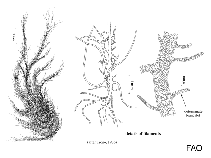
Thalli form light green, dense mats consisting of richly branched soft, delicate and hair-like hollow filaments, either attached to solid substrate or floating. Cells 120 to 340 um in diameter and arranged in longitudinal rows. Determinate branchlets uniseriate at or near their tips.
Fronds are up to 40 cm in height (Ref. 801). Used for human consumption (contains vitamin A and vitamin B1), animal feed, fertilizer and has an antibacterial property (Ref. 80758), and is also used as bait for fish traps (Ref. 801). Attached to rocks or other solid substrates in supratidal to upper intertidal areas, or on exposed surfaces; also floating along with other algal species (Ref. 80758). Also on reef crest with coral rubble (Ref. 87157).
Cycle de vie et comportement reproducteur
Maturité | Reproduction | Frai | Œufs | Fécondité | Larves
Guiry, M.D. and G.M. Guiry 2009 AlgaeBase. World-wide electronic publication, National University of Ireland, Galway. http://www.algaebase.org; searched on 14 April 2009. (Réf. 80701)
Statut dans la liste rouge de l'IUCN
(Réf. 130435: Version 2025-2 (Global))
statut CITES (Réf. 108899)
Not Evaluated
Not Evaluated
Menace pour l'homme
Utilisations par l'homme
Pêcheries: commercial
FAO - Publication: search | FishSource |
Outils
Plus d'informations
Écologie trophiqueAliments (proies)
Composition du régime alimentaire
Consommation alimentaire
Prédateurs
Dynamique des populationsCroissanceÂges / tailles maximalesLongueur-poids rel.Rel. longueur-longueur.Fréquences de longueursConversion de masseAbondance Cycle de vieReproductionMaturitéFéconditéFraiŒufsDéveloppement de l'œufLarves PhysiologieConsommation d'oxygène
Liées à l'hommeTimbres, pièces de monnaie, divers
Sources Internet
Estimations basées sur des modèles
Vulnérabilité de la pêche
(Réf. 71543) |
Low vulnerability (10 of 100). |