Phaeophyceae |
Fucales |
Sargassaceae
Umwelt: Milieu / Klimazone / Tiefenbereich / Verbreitungsgebiet
Ökologie
Sessile. Tropical
Indo-West Pacific.
Länge bei der ersten Reifung / Größe / Gewicht / Alter
Geschlechtsreife: Lm ? range ? - ? cm
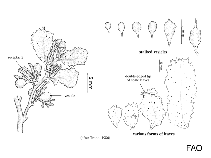
Holdfast small, discoid; stem short, cylindrical, large at base, slightly tapered to tip, smooth or partly smooth and slightly warty. Primary branches smooth, slightly compressed near base, becoming cylindrical toward upper portions. Leaves coriaceous, obovate, 10mm long, 8 mm wide; stalk very short, almost sessile, with coarse teeth; base (thick) acute, slightly asymmetrical in some; margin coarsely serrate, serrations arranged in single or double rows; distal third of most leaves expanded into a cup-like structure of mainly elliptical to oblong shape when viewed from top view of leaf, resembling the leave structure of Turbinaria; midrib not apparent even at base. Cryptostomata scattered, very apparent, and slightly elevated. Vesicles numerous, some enlarged, up to 12 mm long, 6 mm wide, generally elliptical-oblong or slightly oblong-obovate; stalk very short, less than 1/4 length of vesicle; vesicles irregularly lumpy because of cryptostomata; some vesicles slightly ribbed with or without coronal leaf, those without coronal leaf with a row of coarse spines on upper half. Receptacles irregularly cymose with short, once or twice branched; receptacular branches terete at lower half, slightly compressed toward distal half, with occasional teeth along the margin. Primary branches up to 50 cm in length (Ref. 80758).
Used for human consumption as source of alginate, mainly used as emulsifying, stabilizing and gelling agents in food products such as frozen food, pastries, desserts, jellies, salad dressings, ice creams, meat and flavor sauces, beer, fruit juices, and milk shakes; contains iodine, protein vitamin C, and minerals like Ca, K, Mg, Na, Cu, Zn, S, P, Mn; used as medicine: for goiter, glandular troubles, as antibacteria and antitumor; source of tannins and phenols; also used for animal feeds and fertilizers (Ref. 80758).
Lebenszyklus und Paarungsverhalten
Geschlechtsreife | Fortpflanzung | Ablaichen | Eier | Fruchtbarkeit | Larven
Guiry, M.D. and G.M. Guiry 2009 AlgaeBase. World-wide electronic publication, National University of Ireland, Galway. http://www.algaebase.org; searched on 14 April 2009. (Ref. 80701)
IUCN Rote Liste Status
(Ref. 130435: Version 2025-2 (Global))
CITES Status (Ref. 108899)
Not Evaluated
Not Evaluated
Bedrohung für Menschen
Nutzung durch Menschen
Fischereien: kommerziell
FAO - Publication: search | FishSource |
Tools
Mehr Information
Trophische ÖkologieLebensmittel (Beutetiere)
Nahrungszusammensetzung
Nahrungsaufnahme
Räuber
PopulationsdynamikWachstum
Max. Alter/Größen
Länge-Gewicht-Rel.
Länge-Länge-Verhältnis.
Längenhäufigkeiten
Massenkonvertierung
Dichte
LebenszyklusFortpflanzungGeschlechtsreifeFruchtbarkeitAblaichenEierEientwicklungLarven PhysiologieSauerstoffverbrauch
MenschenbezogenBriefmarken, Münzen, Verschiedenes.
Internet Quellen
Schätzungen auf der Grundlage von Modellen
Anfälligkeit der Fischerei
(Ref. 71543) |
(0 of 100). |