Malacostraca |
Isopoda |
Chaetiliidae
Umwelt: Milieu / Klimazone / Tiefenbereich / Verbreitungsgebiet
Ökologie
Benthic; tiefenbereich 0 - 580 m (Ref. 3113). Polar
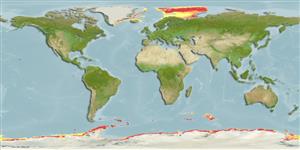
Northeast Atlantic and the Antarctic.
Länge bei der ersten Reifung / Größe / Gewicht / Alter
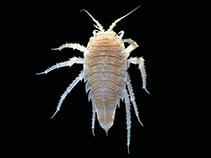
Geschlechtsreife: Lm ? range ? - ? cm Max length : 9.0 cm TL Männchen/unbestimmt; (Ref. 8360)
Depth range based on a locality (Ref. 3113); to be replaced with a better reference. High motile and eurybathic. Common in intertidal and subtidal areas. Associated with epizoic bryozoans; larger isopods had significantly more and diverse bryozoan colonies. Epibiosis, in this relationship, appears to be advantageous (Ref. 117942).
Lebenszyklus und Paarungsverhalten
Geschlechtsreife | Fortpflanzung | Ablaichen | Eier | Fruchtbarkeit | Larven
Members of the order Isopoda are mostly gonochoric. Mating behavior: Mating usually occurs before and sometimes during the parturial molt. Sperm transfer is indirect. Life cycle: Eggs are brooded in the marsupium, which later hatch into manca postlarva before developing into adults.
Held, C. and J.-W. Wägele 2005 Cryptic speciation in the giant Antarctic isopod Glyptonotus antarcticus (Isopoda: Valvifera: Chaeteliidae). Scientia Marina 69 (Suppl. 2):175-181. (Ref. 8360)
IUCN Rote Liste Status
(Ref. 130435: Version 2025-2 (Global))
CITES Status (Ref. 108899)
Not Evaluated
Not Evaluated
Bedrohung für Menschen
Nutzung durch Menschen
FAO - Publication: search | FishSource |
Tools
Mehr Information
Trophische ÖkologieLebensmittel (Beutetiere)NahrungszusammensetzungNahrungsaufnahmeRäuber PopulationsdynamikWachstum
Max. Alter/Größen
Länge-Gewicht-Rel.
Länge-Länge-Verhältnis.
Längenhäufigkeiten
Massenkonvertierung
Dichte
LebenszyklusFortpflanzungGeschlechtsreifeFruchtbarkeitAblaichenEierEientwicklungLarven PhysiologieSauerstoffverbrauch
MenschenbezogenBriefmarken, Münzen, Verschiedenes.
Internet Quellen
Schätzungen auf der Grundlage von Modellen
Anfälligkeit der Fischerei
(Ref. 71543) |
Low vulnerability (10 of 100). |
Preiskategorie
(Ref. 80766): |
Unknown. |