Phaeophyceae |
Dictyotales |
Dictyotaceae
Environnement : milieu / zone climatique / profondeur / gamme de distribution
Écologie
Sessile; profondeur 0 - 15 m (Réf. 80758), usually 2 - 2 m (Réf. 80758). Tropical
Atlantic and Pacific Ocean.
Longueur à la première maturité / Taille / Poids / Âge
Maturité: Lm ? range ? - ? cm
Description synthétique
Morphologie
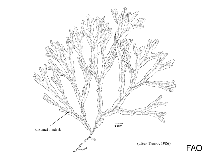
Greenish brown, erect and bushy thalli attached by a discoid holdfast to the substrate. Branching alternate-dichotomous, forming rounded axils. Branches strap-shaped, 2.5 to 10 mm across, broadest just below the forking, narrowest at the terminal portions. Segments between the dichotomies decrease in length from base to the distal end of the thallus. Apices of terminal segments rounded to obtuse when young, dentate or aculeate when mature. Outer margins of blades entire. Thalli up to 15 cm in height (Ref. 80758).
Good source of alginate which is used as an emulsifying, stabilizing and gelling agent in food such as pastries, jellies, salad dressings, ice creams, meat and flavor sources, beer, fruit juices and milk shakes (Ref. 80758); presence of metabolite dictyol H, a diterpene carbon skeleton. Abundant and inhabits rocks in shallow waters with moderate currents from the intertidal and subtidal zone at depths of 15 m; most common at about 2 m depth where the water is clear and unpolluted (Ref. 80758).
Cycle de vie et comportement reproducteur
Maturité | Reproduction | Frai | Œufs | Fécondité | Larves
Guiry, M.D. and G.M. Guiry 2009 AlgaeBase. World-wide electronic publication, National University of Ireland, Galway. http://www.algaebase.org; searched on 14 April 2009. (Réf. 80701)
Statut dans la liste rouge de l'IUCN
(Réf. 130435: Version 2025-2 (Global))
statut CITES (Réf. 108899)
Not Evaluated
Not Evaluated
Menace pour l'homme
Utilisations par l'homme
FAO - Publication: search | FishSource |
Outils
Plus d'informations
Écologie trophiqueAliments (proies)
Composition du régime alimentaire
Consommation alimentaire
Prédateurs
Dynamique des populationsCroissance
Âges / tailles maximales
Longueur-poids rel.
Rel. longueur-longueur.
Fréquences de longueurs
Conversion de masse
Abondance
Cycle de vieReproductionMaturitéFéconditéFraiŒufsDéveloppement de l'œufLarves PhysiologieConsommation d'oxygène
Liées à l'hommeTimbres, pièces de monnaie, divers
Sources Internet
Estimations basées sur des modèles
Vulnérabilité de la pêche
(Réf. 71543) |
(0 of 100). |