Florideophyceae |
Gracilariales |
Gracilariaceae
Môi trường: môi trường / vùng khí hậu / Mức độ sâu / phạm vi phân phối
Sinh thái học
Epiphytic. Tropical
Pacific Ocean: Fiji, Samoa and American Samoa.
Chiều dài lúc trưởng thành đầu tiên / Bộ gần gũi / Khối lượng (Trọng lượng) / Tuổi
Chín muồi sinh dục: Lm ? range ? - ? cm Max length : 50.0 cm PL con đực/không giới tính; (Tài liệu tham khảo 82232); common length : 20.0 cm PL con đực/không giới tính; (Tài liệu tham khảo 82232)
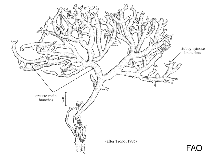
At Navulivatu Settlement, Serua, Fiji, thalli of G. maramae were about 2 mm. G. maramae generally has long internodal distances and is not profusely branched, so often resembles spaghetti noodles. Plant length can be up to 500 mm though 200 mm is typical Plants were found individually scattered on sandy substrates, attached by a holdfast to pieces of shell and were slightly translucent golden brown in colour (Ref. 82232). G. maramae has a long, sparsely branched and quite thick thallus that gives it a characteristic spaghetti-noodles appearance (Ref. 82232).
Has high potential as a source of commercial agar, and hence aquaculture (Ref. 82232). Found in the high subtidal or lower intertidal zones of relatively sheltered rockflats or mudflats and sandbanks. In Laucala Island, Suva Harbour, Fiji, G. maramae was also found attached to holdfasts to buried pebbles or shells. In Corpus Cristi, Suva Harbour, Fiji, G. maramae plants up to 500 mm in length, attached by holdfasts, were found along the edge of the intertidal mudflat (near the navigational marks) in the high subtidal zone where the bottom slopes away into the shipping channel. Unattached plants were also found entangled in kuku (date mussels) beds and washed up into the intertidal zone; G. maramae plants were large and very abundant in Nasese, Suva harbour, Fiji, and formed dense beds of unattached plants entangled with and often smothering the turtlegrasses. This site represented the largest Gracilaria resource encountered during the survey. In Nasese/Nasova (near Ratu Sukuna Road junction), Suva Harbour, Fiji, G. maramae was abundant, but fairly small. In Draunibota Island, Suva Harbour, Fiji, isolated small G. maramae plants were found entangled with turtlegrasses, but were not abundant. A few small G. maramae plants were found attached by holdfasts in the high subtidal zone in Lami, Suva Harbour, Fiji. In Kaba Peninsula, Fiji, in between the rocky headlands were intertidal sandy pools, often near mangroves and areas with freshwater runoff, these pools were lined up with a mix of species but dominated by at least two species of Laurencia epiphytized Hypnea plants, G. maramae and G. edulis. There was sufficient G. maramae present to enable collection for phycocolloid analysis, but other species were too small (>50 mm) and dirty to warrant collection. Along the water line of Nukusasa sandbar, Fiji were unattached G. maramae. At the northern end there was a small patch of scattered G. maramae plants attached by holdfasts to shell buried in the sand. There were similar patches at the southern end, and on the southwestern side some turtlegrass beds with small Hypneaplants attached. The sandee lee side of Tokatoka ni Kubu Reef has scattered plants of G.maramae and H. pannosa. Drift plants of G. maramae at Vatoa, Fiji, entangled in mangrove roots, presumed to be washed from the adjacent Tokatoka ni Kubu Reef. At the western end of Telau Island, Fiji, scattered small G. maramae plants were found entangled with turtlegrasses and Caulerpa stolons. G. maramae were also found in an area of inter-tidal and high subtidal seagrass meadow on the shoreline near Navulivatu Settlement, Serua District, Fiji. G. maramae plants were found individually scattered on sandy substrates, attached by holdfast to pieces of shell (Ref. 82232).
Vòng đời và hành vi giao phối
Chín muồi sinh dục | Sự tái sinh sản | Đẻ trứng | Các trứng | Sự sinh sản | Ấu trùng
Guiry, M.D. and G.M. Guiry 2009 AlgaeBase. World-wide electronic publication, National University of Ireland, Galway. http://www.algaebase.org; searched on 14 April 2009. (Tài liệu tham khảo 80701)
Tình trạng Sách đỏ IUCN
(Tài liệu tham khảo 130435: Version 2025-2 (Global))
tình trạng CITES (Tài liệu tham khảo 108899)
Not Evaluated
CMS (Tài liệu tham khảo 116361)
Not Evaluated
Mối đe dọa đối với con người
Harmless (Tài liệu tham khảo 82232)
Sử dụng của con người
Các nghề cá: tính thương mại; Nuôi trồng thủy sản: giống như cách dùng trong tương lai
FAO - Publication: search | FishSource |
Các công cụ
Thêm thông tin
Sinh thái dinh dưỡngThức ăn (con mồi)
Thành phần thức ăn
Thành phần thức ăn
Các động vật ăn mồi
Biến động dân sốSự sinh trưởngĐộ tuổi / kích thước tối đaChiều dài-trọng lượng tương đốiChiều dài-chiều dài tương đối.Chiều dài-tần sốChuyển đổi khối lượngSự phong phú Vòng đờiSự tái sinh sảnChín muồi sinh dụcSự sinh sảnĐẻ trứngCác trứngSự phát triển của trứngẤu trùng Sinh lý họcThành phần ô-xy
Liên quan đến con ngườiTem, tiền xu, v.v.
Các nguồn internet
Ước tính dựa trên mô hình
Sự dễ bị tổn thương của nghề đánh cá
(Tài liệu tham khảo 71543) |
Moderate vulnerability (40 of 100). |