Ulvophyceae |
Dasycladales |
Dasycladaceae
Environnement : milieu / zone climatique / profondeur / gamme de distribution
Écologie
Sessile; profondeur 0 - 3 m (Réf. 102136). Tropical
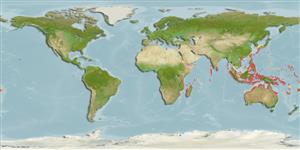
Indian Ocean: Tanzania to Madagascar, east to Singapore and south to Dampier Western Australia; Pacific Ocean: from China to Queensland, Australia, including Japan, Vietnam, Philippines, Papua New Guinea, Federated States of Micronesia and Fiji.
Longueur à la première maturité / Taille / Poids / Âge
Maturité: Lm ? range ? - ? cm
Description synthétique
Morphologie
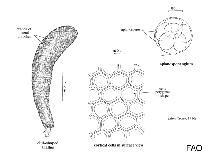
Thallus green to brownish red, usually bent, club-shaped, attached to substrate by a small rhizoidal holdfast. Cross section of thallus shows a cylindrical axial filament extending almost the whole length of the thallus. Successive whorls of lateral branches cover the thallus, each whorl consisting of 24 to 28 primary lateral branches, slightly expanded at their distal ends and giving rise to 4 to 7 short capitate branchlets laterally coherent forming a monostromatic cortex. Cortical cells polygonal in surface view. Each primary lateral branch with 4 or more aplanosporangia, 150 to 190 μm in diameter and containing 2 to 9 oval or spherical aplanospores, 70 to 80 μm in diameter. Thallus up to 5 cm in height (Ref. 80758).
Grows in colonies on solid or rocky substrate in mid-tidal to low intertidal areas (Ref. 80758).
Cycle de vie et comportement reproducteur
Maturité | Reproduction | Frai | Œufs | Fécondité | Larves
Guiry, M.D. and G.M. Guiry 2009 AlgaeBase. World-wide electronic publication, National University of Ireland, Galway. http://www.algaebase.org; searched on 14 April 2009. (Réf. 80701)
Statut dans la liste rouge de l'IUCN
(Réf. 130435: Version 2025-2 (Global))
statut CITES (Réf. 108899)
Not Evaluated
Not Evaluated
Menace pour l'homme
Utilisations par l'homme
FAO - Publication: search | FishSource |
Outils
Plus d'informations
Écologie trophiqueAliments (proies)
Composition du régime alimentaire
Consommation alimentaire
Prédateurs
Dynamique des populationsCroissance
Âges / tailles maximales
Longueur-poids rel.
Rel. longueur-longueur.
Fréquences de longueurs
Conversion de masse
Abondance
Cycle de vieReproductionMaturitéFéconditéFraiŒufsDéveloppement de l'œufLarves PhysiologieConsommation d'oxygène
Liées à l'hommeTimbres, pièces de monnaie, divers
Sources Internet
Estimations basées sur des modèles
Vulnérabilité de la pêche
(Réf. 71543) |
(0 of 100). |