Bryopsidophyceae |
Bryopsidales |
Codiaceae
Environnement : milieu / zone climatique / profondeur / gamme de distribution
Écologie
Epiphytic. Tropical
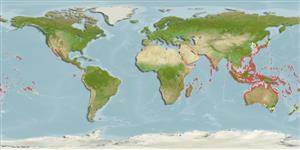
Indian Ocean: from Egypt to Mozambique, including the Red Sea, Seychelles, Madagascar, Mauritius, Réunion, Rodrigues and Mascarene Islands, east to India and south to Dampier, Western Australia, including Andaman Sea, Laccadive Islands, Maldives, Sri Lanka and Nicobar Islands; Pacific Ocean: from China to the south China Sea, south to New Zealand, including Federated States of Micronesia, Fiji, Norfolk Islands, the Great Barrier Reef, Lord Howe Island, Tasmania and French Polynesia, east to Chile, including Samoan Archipelago and Hawaiian Islands.
Longueur à la première maturité / Taille / Poids / Âge
Maturité: Lm ? range ? - ? cm
Description synthétique
Morphologie
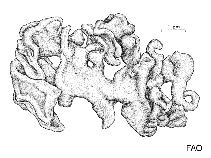
Thallus forming a dark green, amorphous to convoluted spongy mass, composed of central medulla and cortex. Medulla consisting of branched cylindrical filaments, their tips inflated into cylindrical to clavate utricles forming the cortex.Hairs or hair scars occur in 1 to 3 vertical rows, at some distance from the tip of the utricle. Gametangia cylindrical and tapering towards both ends, borne at the side of the proximal portion of the utricle. Amorphous clumps up to 5 cm in diameter (Ref. 80758).
Used for human consumption and as medicine (Ref. 80758). Inhabits lower intertidal to shallow subtidal areas where it grows encrusted on sandy-rocky substrate or epiphytic on stipes of larger seaweeds and midribs of the seagrass Enhalus (Ref. 80758).
Cycle de vie et comportement reproducteur
Maturité | Reproduction | Frai | Œufs | Fécondité | Larves
Guiry, M.D. and G.M. Guiry 2009 AlgaeBase. World-wide electronic publication, National University of Ireland, Galway. http://www.algaebase.org; searched on 14 April 2009. (Réf. 80701)
Statut dans la liste rouge de l'IUCN
(Réf. 130435: Version 2025-2 (Global))
statut CITES (Réf. 108899)
Not Evaluated
Not Evaluated
Menace pour l'homme
Utilisations par l'homme
Pêcheries: commercial
FAO - Publication: search | FishSource |
Outils
Plus d'informations
Écologie trophiqueAliments (proies)
Composition du régime alimentaire
Consommation alimentaire
Prédateurs
Dynamique des populationsCroissanceÂges / tailles maximalesLongueur-poids rel.Rel. longueur-longueur.Fréquences de longueursConversion de masseAbondance Cycle de vieReproductionMaturitéFéconditéFraiŒufsDéveloppement de l'œufLarves PhysiologieConsommation d'oxygène
Liées à l'hommeTimbres, pièces de monnaie, divers
Sources Internet
Estimations basées sur des modèles
Vulnérabilité de la pêche
(Réf. 71543) |
(0 of 100). |