Florideophyceae |
Gigartinales |
Areschougiaceae
Umwelt: Milieu / Klimazone / Tiefenbereich / Verbreitungsgebiet
Ökologie
Sessile. Tropical
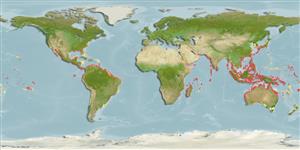
Atlantic Ocean: in the Caribbean (in Lesser Antilles). Indian Ocean: from Djibouti to South Africa, including Reunion, east to India and south to Western Australia, including Andaman and Nicobar Islands. Pacific Ocean: from China to the South China Sea south to Queensland Australia, including Lord Howe Island and Fiji, east to the Hawaiian Islands.
Länge bei der ersten Reifung / Größe / Gewicht / Alter
Geschlechtsreife: Lm ? range ? - ? cm
Thalli consist of many terete branches, tapering to acute tips, densely covered with 1 to 8 mm long spinose determinate branchlets arranged in whorls, forming distinct nodes and internodes at the distal portions of the branches. Cross-section of a branch reveals a dense core of thick-walled and very small rhizoidal cells. Thalli up to 30 cm in height (Ref. 80758). The fusion of branches upon coming in contact with each other and their ability to form secondary holdfasts at tips of branches results in the formation of thick and strongly attached clumps or carpet-like beds (Ref. 80758).
Used for human consumption in stews, eaten fresh, or blanched in boiling water, or made into Eucheuma candy, or as garnishing; principal source of phycocolloid carrageenan (iota); controls heavy metal pollution (Pb, Cd); used as manure in industrial products and processes; used in animal feeds (Ref. 80758). Thrives very well on sandy-coralline to rocky substrate in areas constantly exposed to moderate to strong water currents; commonly found growing strongly attached to coralline gravelly-rocky or coarse sandy-rocky substrate at the intertidal to the upper (shallow) subtidal zone on the reefs exposed to moderate wave action or strong tidal currents where it may form thick clumps or beds. The fusion of branches upon coming in contact with each other and their ability to form secondary holdfasts at tips of branches results in the formation of thick and strongly attached clumps or carpet-like beds which are able to withstand moderate to strong water movement. Has never been reported from calm or protected habitats (Ref. 80758).
Lebenszyklus und Paarungsverhalten
Geschlechtsreife | Fortpflanzung | Ablaichen | Eier | Fruchtbarkeit | Larven
Guiry, M.D. and G.M. Guiry 2009 AlgaeBase. World-wide electronic publication, National University of Ireland, Galway. http://www.algaebase.org; searched on 14 April 2009. (Ref. 80701)
IUCN Rote Liste Status
(Ref. 130435: Version 2025-2 (Global))
CITES Status (Ref. 108899)
Not Evaluated
Not Evaluated
Bedrohung für Menschen
Nutzung durch Menschen
Fischereien: kommerziell
FAO - Aquaculture Systems: production search; Publication: search | FishSource |
Tools
Mehr Information
Trophische ÖkologieLebensmittel (Beutetiere)
Nahrungszusammensetzung
Nahrungsaufnahme
Räuber
PopulationsdynamikWachstumMax. Alter/GrößenLänge-Gewicht-Rel.Länge-Länge-Verhältnis.LängenhäufigkeitenMassenkonvertierungDichte LebenszyklusFortpflanzungGeschlechtsreifeFruchtbarkeitAblaichenEierEientwicklungLarven PhysiologieSauerstoffverbrauch
MenschenbezogenBriefmarken, Münzen, Verschiedenes.
Internet Quellen
Schätzungen auf der Grundlage von Modellen
Anfälligkeit der Fischerei
(Ref. 71543) |
(0 of 100). |