Bivalvia |
Adapedonta |
Pharidae
Environnement : milieu / zone climatique / profondeur / gamme de distribution
Écologie
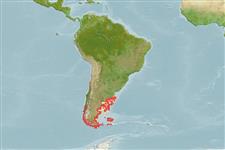
Benthic; profondeur 0 - 55 m (Réf. 82660). Temperate; 19°S - 57°S, 76°W - 61°W
Southern Pacific (27 to 55°S) and Atlantic (40 to 50°S): Chile and Argentina. Subtropical to temperate.
Longueur à la première maturité / Taille / Poids / Âge
Maturité: Lm ? range ? - ? cm Max length : 16.5 cm SHL mâle / non sexé; (Réf. 122430)
Deep burrowing species (Ref. 93290). Found in coastal waters (Ref. 1051996), from low intertidal (Ref. 122429) to depths of 55 m (Ref. 105196, 122429). Found buried in shallow subtidal soft bottoms, specifically in coarse sandy sediments or silty sands at depths of 2 to 50 (Ref. 105111). Also found in fine sand (Ref. 93290).
Cycle de vie et comportement reproducteur
Maturité | Reproduction | Frai | Œufs | Fécondité | Larves
Members of the class Bivalvia are mostly gonochoric, some are protandric hermaphrodites. Life cycle: Embryos develop into free-swimming trocophore larvae, succeeded by the bivalve veliger, resembling a miniature clam.
Barón, P.J., L.E. Real, N.F. Ciocco and M.E. Ré. 2004 Morphology, growth and reproduction of an Atlantic population of the razor clam Ensis macha (Molina, 1782). Scientia Marina 68(2):211-217. (Réf. 2805)
Statut dans la liste rouge de l'IUCN
(Réf. 130435: Version 2025-2 (Global))
statut CITES (Réf. 108899)
Not Evaluated
Not Evaluated
Menace pour l'homme
Harmless
Utilisations par l'homme
Pêcheries: commercial
FAO - Publication: search | FishSource |
Outils
Plus d'informations
Dynamique des populationsCroissanceÂges / tailles maximalesLongueur-poids rel.Rel. longueur-longueur.Fréquences de longueursConversion de masseAbondance Cycle de vieReproductionMaturitéFéconditéFraiŒufsDéveloppement de l'œufLarves PhysiologieConsommation d'oxygène
Liées à l'hommeTimbres, pièces de monnaie, divers
Sources Internet
Estimations basées sur des modèles
Vulnérabilité de la pêche
(Réf. 71543) |
Low to moderate vulnerability (34 of 100). |