Malacostraca |
Isopoda |
Sphaeromatidae | Dynameninae
Environnement : milieu / zone climatique / profondeur / gamme de distribution
Écologie
Benthic. Tropical
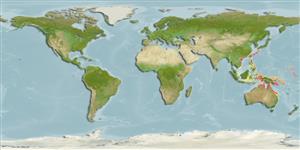
Western Central Pacific: Australia and Viet Nam.
Longueur à la première maturité / Taille / Poids / Âge
Maturité: Lm ? range ? - ? cm Max length : 3.4 cm BL (female)
Inhabits shallow waters (Ref. 3113). Found among barnacles, rocky oysters and rock crevices in mid to lower rocky shore (Ref. 8085). Found within the intertidal zone, belt of Crassostrea mordax (Ref. 81176).
Cycle de vie et comportement reproducteur
Maturité | Reproduction | Frai | Œufs | Fécondité | Larves
Members of the order Isopoda are mostly gonochoric. Mating behavior: Mating usually occurs before and sometimes during the parturial molt. Sperm transfer is indirect. Life cycle: Eggs are brooded in the marsupium, which later hatch into manca postlarva before developing into adults.
Schotte, M., B.F. Kensley and S. Shilling 1995 World list of marine, freshwater and terrestrial crustacea isopoda. National Museum of Natural History Smithsonian Institution: Washington D.C., USA. Http://www.nmnh.si.edu/iz/isopod/ [Accessed 07/03/01]. (Réf. 3113)
Statut dans la liste rouge de l'IUCN
(Réf. 130435: Version 2025-2 (Global))
statut CITES (Réf. 108899)
Not Evaluated
Not Evaluated
Menace pour l'homme
Utilisations par l'homme
FAO - Publication: search | FishSource |
Outils
Plus d'informations
Écologie trophiqueAliments (proies)
Composition du régime alimentaire
Consommation alimentaire
Prédateurs
Dynamique des populationsCroissance
Âges / tailles maximales
Longueur-poids rel.
Rel. longueur-longueur.
Fréquences de longueurs
Conversion de masse
Abondance
Cycle de vieReproductionMaturitéFéconditéFraiŒufsDéveloppement de l'œufLarves PhysiologieConsommation d'oxygène
Liées à l'hommeTimbres, pièces de monnaie, divers
Sources Internet
Estimations basées sur des modèles
Vulnérabilité de la pêche
(Réf. 71543) |
Low vulnerability (10 of 100). |
Catégorie de prix
(Réf. 80766): |
Unknown. |