Gastropoda |
Not assigned |
Potamididae
Umwelt: Milieu / Klimazone / Tiefenbereich / Verbreitungsgebiet
Ökologie
Benthic. Tropical
Western Pacific.
Länge bei der ersten Reifung / Größe / Gewicht / Alter
Geschlechtsreife: Lm ? range ? - ? cm
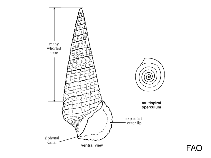
Shell high, with 10 to whorls, flat sided. Two channels and an impressed suture can be found on the upper whorls, and about 10 channels on the body whorl are crossed by axial ribs, producing squarish beads. Beads on each whorl are all of similar size. Outer lip is flared in aduls, and thickened with both anterior and posterior canals. Columella is smooth, and thickened along full height. Shell is dark brown. Aperture is whitish. Operculum is light brown and horny.
Found in sandy shores, near the vicinity of the depression formed during low tides to avoid desiccation (Ref. 125338). On mud or rock surfaces in mangroves, at the mid to upper intertidal levels (Ref. 128877). Part of both epibenthic and arboreal communities (Ref. 128397).
Lebenszyklus und Paarungsverhalten
Geschlechtsreife | Fortpflanzung | Ablaichen | Eier | Fruchtbarkeit | Larven
Members of the order Neotaenioglossa are mostly gonochoric and broadcast spawners. Life cycle: Embryos develop into planktonic trocophore larvae and later into juvenile veligers before becoming fully grown adults.
Poppe, G.T. 2008 Philippine marine mollusks. Vol. 1 (Gastropoda - Part 1). ConchBooks. 759 p. (Ref. 86518)
IUCN Rote Liste Status
(Ref. 130435: Version 2025-2 (Global))
CITES Status (Ref. 108899)
Not Evaluated
Not Evaluated
Bedrohung für Menschen
Nutzung durch Menschen
FAO - Publication: search | FishSource |
Tools
Mehr Information
Trophische ÖkologieLebensmittel (Beutetiere)
Nahrungszusammensetzung
Nahrungsaufnahme
Räuber
PopulationsdynamikWachstumMax. Alter/GrößenLänge-Gewicht-Rel.Länge-Länge-Verhältnis.LängenhäufigkeitenMassenkonvertierungDichte LebenszyklusFortpflanzungGeschlechtsreifeFruchtbarkeitAblaichenEierEientwicklungLarven PhysiologieSauerstoffverbrauch
MenschenbezogenBriefmarken, Münzen, Verschiedenes.
Internet Quellen
Schätzungen auf der Grundlage von Modellen
Anfälligkeit der Fischerei
(Ref. 71543) |
(0 of 100). |