Gastropoda |
Neogastropoda |
Nassariidae
Umwelt: Milieu / Klimazone / Tiefenbereich / Verbreitungsgebiet
Ökologie
Benthic. Subtropical
Mediterranean Sea.
Länge bei der ersten Reifung / Größe / Gewicht / Alter
Geschlechtsreife: Lm ? range ? - ? cmCommon length : 1.3 cm SHL Männchen/unbestimmt; (Ref. 360)
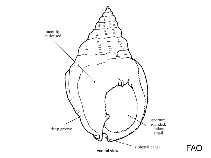
Shell: quite thick and strong, a rather high conical spire, short siphonal canal, open and twisted; body whorl is very large, spherical, covering much of the preceding one, involute, suture is hardly incised; aperture is ovoidal, outer lip has an external thickening and thin internal folds; in adults, columellar lip forms a large callus that completely covers the ventral surfaces of the body whorl; no sculpture except for a rib with one, two of three hardly visible blunt nodules, on the periphery of the dorsal surface of the body whorl; color is yellowish or yellow brown, callus and lips are white; operculum is horny, yellowish, has an apical nucleus, roughly triangular, fringed inner and outer margins. Body: wide triangular foot, many nassariids, two appendices at the posterior end; very long mantle siphon; radula is rachiglossan.
Lebenszyklus und Paarungsverhalten
Geschlechtsreife | Fortpflanzung | Ablaichen | Eier | Fruchtbarkeit | Larven
This species is a non-broadcast spawner. Life cycle does not include trocophore stage. Also Ref. 833.
Templado, J. and R. Villanueva 2010 Checklist of Phylum Mollusca. pp. 148-198 In Coll, M., et al., 2010. The biodiversity of the Mediterranean Sea: estimates, patterns, and threats. PLoS ONE 5(8):36pp. (Ref. 85339)
IUCN Rote Liste Status
(Ref. 130435: Version 2025-2 (Global))
CITES Status (Ref. 108899)
Not Evaluated
Not Evaluated
Bedrohung für Menschen
Harmless
Nutzung durch Menschen
FAO - Publication: search | FishSource |
Tools
Mehr Information
Trophische ÖkologieLebensmittel (Beutetiere)
Nahrungszusammensetzung
Nahrungsaufnahme
Räuber
PopulationsdynamikWachstum
Max. Alter/Größen
Länge-Gewicht-Rel.
Länge-Länge-Verhältnis.
Längenhäufigkeiten
Massenkonvertierung
Dichte
LebenszyklusFortpflanzungGeschlechtsreifeFruchtbarkeitAblaichenEierEientwicklungLarven PhysiologieSauerstoffverbrauch
MenschenbezogenBriefmarken, Münzen, Verschiedenes.
Internet Quellen
Schätzungen auf der Grundlage von Modellen
Anfälligkeit der Fischerei
(Ref. 71543) |
(0 of 100). |