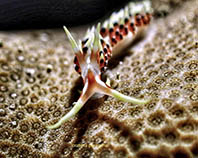
Gastropoda |
Nudibranchia |
Facelinidae
Environnement : milieu / zone climatique / profondeur / gamme de distribution
Écologie
Benthic. Subtropical
Mediterranean Sea.
Longueur à la première maturité / Taille / Poids / Âge
Maturité: Lm ? range ? - ? cm
Feeds directly on the hydranths of Eudendrium racemosum (Ref. 116462), wherein it's stimulated to feed and prefers hydranths which have captured the plankton, thus ingesting both the plankton and the hydroid polyp---a combination of predation and kleptoparasitism, a type of competition of stealing already captured food items. This combination does not fit into existing classifications, thus called 'kleptopredation.' Despite being an opportunistic predator which uses hydroids to capture prey from the column, hydranth forms only a fraction of its diet by volume. Plankton form at least half of its diet.
Cycle de vie et comportement reproducteur
Maturité | Reproduction | Frai | Œufs | Fécondité | Larves
Members of the order Nudibranchia are simultaneous hermaphrodites. Mating behavior: Both individuals darts their penis toward each other to induce one to act as a male and the other as the female. The victorious one to penetrate the body wall is the dominant male. Life cycle: Eggs are deposited on a substratum where they develop and hatch into (planktonic) vestigial veliger larval stage and further grow as adults.
Templado, J. and R. Villanueva 2010 Checklist of Phylum Mollusca. pp. 148-198 In Coll, M., et al., 2010. The biodiversity of the Mediterranean Sea: estimates, patterns, and threats. PLoS ONE 5(8):36pp. (Réf. 85339)
Statut dans la liste rouge de l'IUCN
(Réf. 130435: Version 2025-2 (Global))
statut CITES (Réf. 108899)
Not Evaluated
Not Evaluated
Menace pour l'homme
Harmless
Utilisations par l'homme
FAO - Publication: search | FishSource |
Outils
Plus d'informations
Dynamique des populationsCroissance
Âges / tailles maximales
Longueur-poids rel.
Rel. longueur-longueur.
Fréquences de longueurs
Conversion de masse
Abondance
Cycle de vieReproductionMaturitéFéconditéFraiŒufsDéveloppement de l'œufLarves PhysiologieConsommation d'oxygène
Liées à l'hommeTimbres, pièces de monnaie, divers
Sources Internet
Estimations basées sur des modèles
Vulnérabilité de la pêche
(Réf. 71543) |
(0 of 100). |