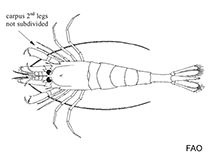
Malacostraca |
Decapoda |
Crangonidae
Environnement : milieu / zone climatique / profondeur / gamme de distribution
Écologie
Benthic; profondeur 200 - 1320 m (Réf. 87391), usually 200 - 600 m (Réf. 2660). Deep-water
Southern Oceans: Southern tip of South America, South Georgia and Antarctic Continental Shelf.
Longueur à la première maturité / Taille / Poids / Âge
Maturité: Lm ? range ? - ? cm
Known as one of the most abundant shelf inhabiting Antarctic shrimps (Ref. 86805). Minimum depth from Ref. 2660. Found in the continental shelves and slopes at depths of 200 to 600 m; digging itself ventrally into the sediment (Ref. 2660).
Cycle de vie et comportement reproducteur
Maturité | Reproduction | Frai | Œufs | Fécondité | Larves
Members of the order Decapoda are mostly gonochoric. Mating behavior: Precopulatory courtship ritual is common (through olfactory and tactile cues); usually indirect sperm transfer.
Gorny, M. 1999 On the biogeography and ecology of the Southern Ocean decapod fauna. Scientia Marina 63(1):367-382. (Réf. 87391)
Statut dans la liste rouge de l'IUCN
(Réf. 130435: Version 2025-2 (Global))
statut CITES (Réf. 108899)
Not Evaluated
Not Evaluated
Menace pour l'homme
Harmless
Utilisations par l'homme
FAO - Publication: search | FishSource |
Outils
Plus d'informations
Écologie trophiqueAliments (proies)
Composition du régime alimentaire
Consommation alimentaire
Prédateurs
Dynamique des populationsCroissanceÂges / tailles maximalesLongueur-poids rel.Rel. longueur-longueur.Fréquences de longueursConversion de masseAbondance Cycle de vieReproductionMaturitéFéconditéFraiŒufsDéveloppement de l'œufLarves Liées à l'hommeTimbres, pièces de monnaie, divers
Sources Internet
Estimations basées sur des modèles
Vulnérabilité de la pêche
(Réf. 71543) |
(0 of 100). |