Ophiuroidea |
Euryalida |
Gorgonocephalidae
Milieu: milieu / Klimaatzone / Diepte / verspreidingsgebied
Ecologie
Benthic; diepte 20 - 1180 m (Ref. 87801). Polar
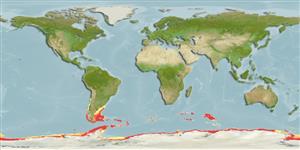
Southeast Pacific, Southwest Atlantic and Antarctic.
Lengte bij maturiteit / Grootte / Gewicht / Leeftijd
Maturiteit: Lm ? range ? - ? cm
It is found on gorgonians from the genera Primnoella and Thouarella at depths of 20 to 1180 m (Ref. 87801).
Levenscyclus en paargedrag
Maturiteit | Voortplanting | Paaien | Eieren | Fecunditeit | Larven
Members of the class Ophiuroidea are mostly gonochoric, others are protandric. Fertilization is external. Brooding is common, bursae is used as brood chambers where the embryos develop into juveniles and later crawl out from the bursal slits. Life cycle: Embryos hatch into free-swimming planktotrophic larvae and later metamorphose into tiny brittle stars which sink down the bottom where they grow into adult form.
Stöhr, S. 2010 Astrotoma agassizii Lyman, 1875. In Stöhr, S., O’Hara, T. (Eds) (2010). World Ophiuroidea database. Accessed through: De Broyer, C.; Clarke, A.; Koubbi, P.; Pakhomov, E.; Scott, F.; Vanden Berghe, E. and Danis, B. (Eds). The SCAR-MarBIN Register of Antarctic Marine Species (RAMS) at http://www.scarmarbin.be/rams.php?p=taxdetails&id=173167 on 2011-07-25. (Ref. 87417)
Status op de Rode Lijst van het IUCN
(Ref. 130435: Version 2025-2 (Global))
CITES status (Ref. 108899)
Not Evaluated
Not Evaluated
Gevaar voor de mens
Harmless
Gebruik door de mens
FAO - Publication: search | FishSource |
Tools
Meer informatie
Trofische ecologieVoedsel (prooien)
Dieetsamenstelling
Voedselconsumptie
Predatoren
LevenscyclusVoortplantingMaturiteitFecunditeitPaaienEierenOntwikkeling van de eierenLarven FysiologieZuurstofverbruik
Menselijk gerelateerdPostzegels, munten, diversen.
Internetbronnen
Schattingen op basis van modellen
Kwetsbaarheid van de visserij
(Ref. 71543) |
(0 of 100). |