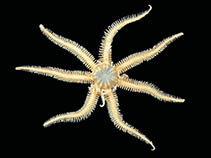
Ophiuroidea |
Ophiacanthida |
Ophiacanthidae
Miljö: miljö / Klimatzon / djupintervall / distributionsområde
Ekologi
Benthic; djupintervall 0 - 1097 m (Ref. 89085). Polar
Southern Pacific, Southwest Atlantic and Antarctic. Temperate to polar.
Längd vid första mognad / Storlek / Vikt / Ålder
Könsmognad: Lm ? range ? - ? cm
It is found on rocks, shells and kelp at depths of 0 to 1097 m (Ref. 87801).
Livscykel och parningsbeteende
Könsmognad | Reproduktion | Lek | Ägg | Fekunditet | Larver
Members of the class Ophiuroidea are mostly gonochoric, others are protandric. Fertilization is external. Brooding is common, bursae is used as brood chambers where the embryos develop into juveniles and later crawl out from the bursal slits. Life cycle: Embryos hatch into free-swimming planktotrophic larvae and later metamorphose into tiny brittle stars which sink down the bottom where they grow into adult form.
Guille, A. 1982 A new genus and species of ophiacanthid brittlestar (Echinodermata: Ophiuroidea) from the Kerguelen Islands, with new taxonomic, biogeographic and quantitative data on the echinoderm fauna. Australian Museum Memoir 16:67-87. (Ref. 87413)
Status på IUCN:s rödlista
(Ref. 130435: Version 2025-2 (Global))
CITES-status (Ref. 108899)
Not Evaluated
Not Evaluated
Hot mot människor
Harmless
Mänskliga användningsområden
FAO - Publication: search | FishSource |
Verktyg
Ytterligare information
Trofisk ekologiLivsmedelsartiklar (preys)
Födosammansättning
Födointag
Predatorer
LivscykelReproduktionKönsmognadFekunditetLekÄggUtveckling av äggLarver MänniskorelateradFrimärken, mynt, diverse.
Internet-källor
Uppskattningar baserade på modeller
Sårbarhet i fisket
(Ref. 71543) |
(0 of 100). |