Gastropoda |
Littorinimorpha |
Calyptraeidae
Environnement : milieu / zone climatique / profondeur / gamme de distribution
Écologie
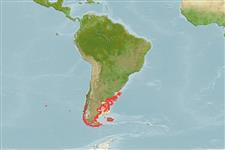
Sessile; profondeur 0 - 66 m (Réf. 83435). Temperate; 35°S - 56°S, 74°E - 56°E (Réf. 83435)
Southeast Pacific and Southwest Atlantic.
Longueur à la première maturité / Taille / Poids / Âge
Maturité: Lm ? range ? - ? cm Max length : 6.0 cm DL mâle / non sexé; (Réf. 83435)
It is found on rocky substrates where it is attached to boulders, cobbles, pebbles, and epibiotic on bivalves, Aulacomya atra and the barnacle Austromegabalanus psittacus (Ref. 87801), and in forests of Macrocystis pyrifera (Ref. 92889).
Cycle de vie et comportement reproducteur
Maturité | Reproduction | Frai | Œufs | Fécondité | Larves
This is a hermaphrotic species. Egg masses are composed of 29 egg capsules, each one containing up to 721 eggs, and are retained beneath the female shell. Only a few of the eggs develop and the others serve as nutritional eggs (Ref. 87801). It displays poecilogonony as its reproductive strategy (Ref. 99837).
Rosenberg, G. 2009 Malacolog 4.1.1: A Database of Western Atlantic Marine Mollusca. [WWW database (version 4.1.1)] URL http://www.malacolog.org/. (Réf. 83435)
Statut dans la liste rouge de l'IUCN
(Réf. 130435: Version 2025-2 (Global))
statut CITES (Réf. 108899)
Not Evaluated
Not Evaluated
Menace pour l'homme
Utilisations par l'homme
FAO - Publication: search | FishSource |
Outils
Plus d'informations
Écologie trophiqueAliments (proies)
Composition du régime alimentaire
Consommation alimentaire
Prédateurs
Dynamique des populationsCroissance
Âges / tailles maximales
Longueur-poids rel.
Rel. longueur-longueur.
Fréquences de longueurs
Conversion de masse
Abondance
Cycle de vieReproductionMaturitéFéconditéFraiŒufsDéveloppement de l'œufLarves PhysiologieConsommation d'oxygène
Liées à l'hommeTimbres, pièces de monnaie, divers
Sources Internet
Estimations basées sur des modèles
Vulnérabilité de la pêche
(Réf. 71543) |
Low vulnerability (10 of 100). |
Catégorie de prix
(Réf. 80766): |
Unknown. |