Malacostraca |
Decapoda |
Callianassidae
Environnement : milieu / zone climatique / profondeur / gamme de distribution
Écologie
Benthic; saumâtre. Subtropical; 44°N - 31°N, 116°E - 141°E (Réf. 4)
Northwest Pacific.
Longueur à la première maturité / Taille / Poids / Âge
Maturité: Lm ? range ? - ? cmCommon length : 5.0 cm TL mâle / non sexé; (Réf. 4); common length :5 cm TL (female)
Description synthétique
Morphologie
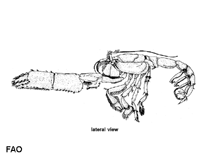
Rostrum very inconspicuous, a wide angle in the anterior margin of the carapace, overreaches the full length of the eyes. The eyes bluntly triangular or quadrangular. Antennal angle likewise inconspicuously triangular, without antennal spine. Antennular peduncle distinctly longer than the antennal peduncle, reaching beyond it with more than half the last segment. Third maxilliped with the ischium and merus expanded to form distinct operculum. Large chela of adult male with a small concavity in the anterior margin of the palm above the fixed finger. Carpus somewhat longer than the palm and longer than high. Merus with a distinct process in the basal half of the lower margin; this process produced forward, ending in a narrowing rounded top. In the females this process reduced to a small triangular tooth. Telson quadrangular slightly shorter than the uropods. The endopod of the uropod broadly triangular with rounded corners (Ref. 4).
It has total body lengths of 1.5 to 5 cm (males), 1 to 5 cm (females) and 2.8 to 5 cm (ovigerous females) (Ref. 4). Habitat: Sand or mud flats of coasts that are more exposed. Behavior: it makes burrows in the soft substrate (Ref. 4).
Cycle de vie et comportement reproducteur
Maturité | Reproduction | Frai | Œufs | Fécondité | Larves
Members of the order Decapoda are mostly gonochoric. Mating behavior: Precopulatory courtship ritual is common (through olfactory and tactile cues); usually indirect sperm transfer.
Holthuis, L.B. 1991 FAO Species Catalogue. Vol. 13. Marine lobsters of the world. An annotated and illustrated catalogue of species of interest to fisheries known to date. FAO Fish. Synop. 125(13):292p. Rome: FAO. (Réf. 4)
Statut dans la liste rouge de l'IUCN
(Réf. 130435: Version 2025-2 (Global))
statut CITES (Réf. 108899)
Not Evaluated
Not Evaluated
Menace pour l'homme
Utilisations par l'homme
Pêcheries: commercial
FAO - Publication: search | FishSource |
Outils
Plus d'informations
Écologie trophiqueAliments (proies)Composition du régime alimentaireConsommation alimentairePrédateurs Dynamique des populationsCroissance
Âges / tailles maximales
Longueur-poids rel.
Rel. longueur-longueur.
Fréquences de longueurs
Conversion de masse
Abondance
Cycle de vieReproductionMaturitéFéconditéFraiŒufsDéveloppement de l'œufLarves PhysiologieConsommation d'oxygène
Liées à l'hommeTimbres, pièces de monnaie, divers
Sources Internet
Estimations basées sur des modèles