Malacostraca |
Decapoda |
Callianassidae
Environnement : milieu / zone climatique / profondeur / gamme de distribution
Écologie
Benthic; profondeur 70 - ? m (Réf. 4). Subtropical; 59°N - 19°N, 19°W - 37°E (Réf. 4)
Atlantic and the Mediterranean.
Longueur à la première maturité / Taille / Poids / Âge
Maturité: Lm ? range ? - ? cmCommon length : 7.0 cm TL mâle / non sexé; (Réf. 4)
Description synthétique
Morphologie
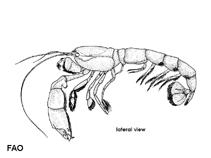
Rostrum short and broadly triangular with tip blunt. Eyes bluntly triangular, reaching beyond rostrum with practically their full length. Antennal angles also bluntly angular, without spine. Antennular peduncle slightly longer than antennal peduncle. Third maxilliped with merus and ischium expanded to form an operculum; last three segments not widened, much narrower and slenderer than operculum. Large chela without deep concavity in anterior margin of palm. Carpus as long as or slightly shorter than palm, and about as long as high. Merus with a rounded lobe in the basal part of the lower margin; this lobe crenulate and not ending in a sharp point. Telson about as long as wide. Lateral margins convex, forming a regular curve with posterior margin. No spines present on telson. Endopod of uropod broadly oval or quadrangular with rounded corners, slightly longer than telson. Colour: pale pink (Ref. 4).
It has a total body length of 7 cm (Ref. 4). It is found from the mesolittoral zone to a depth of a few meters (there are records of depths to 70 m). It burrows in bottoms with well-sorted fine silicate sand with abundant interstitial foraminiferans and diatoms or sand and mud covered by dense meadow of Cymodocea nodosa (Ref. 86850). The burrows have several exits (Ref. 4) which are made up of plant debris and coarse sediment and may be as deep as 62 cm (Ref. 86850).
Cycle de vie et comportement reproducteur
Maturité | Reproduction | Frai | Œufs | Fécondité | Larves
Members of the order Decapoda are mostly gonochoric. Mating behavior: Precopulatory courtship ritual is common (through olfactory and tactile cues); usually indirect sperm transfer.
Holthuis, L.B. 1991 FAO Species Catalogue. Vol. 13. Marine lobsters of the world. An annotated and illustrated catalogue of species of interest to fisheries known to date. FAO Fish. Synop. 125(13):292p. Rome: FAO. (Réf. 4)
Statut dans la liste rouge de l'IUCN
(Réf. 130435: Version 2025-2 (Global))
statut CITES (Réf. 108899)
Not Evaluated
Not Evaluated
Menace pour l'homme
Utilisations par l'homme
Appât: occasionally
FAO - Publication: search | FishSource |
Outils
Plus d'informations
Dynamique des populationsCroissanceÂges / tailles maximalesLongueur-poids rel.Rel. longueur-longueur.Fréquences de longueursConversion de masseAbondance Cycle de vieReproductionMaturitéFéconditéFraiŒufsDéveloppement de l'œufLarves PhysiologieConsommation d'oxygène
Liées à l'hommeTimbres, pièces de monnaie, divers
Sources Internet
Estimations basées sur des modèles