Malacostraca |
Decapoda |
Palinuridae
Environnement : milieu / zone climatique / profondeur / gamme de distribution
Écologie
Benthic; profondeur 72 - 180 m (Réf. 4), usually 72 - 84 m (Réf. 4). Tropical; 36°N - 8°S, 72°E - 141°E (Réf. 4)
Indo-West Pacific.
Longueur à la première maturité / Taille / Poids / Âge
Maturité: Lm 9.6, range 9 - ? cm Max length : 14.0 cm TL mâle / non sexé; (Réf. 122082); common length : 10.0 cm TL mâle / non sexé; (Réf. 4)
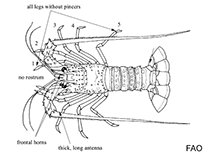
It has lengths of 5 to 10 cm, total body length; 0.8 to 3.2 cm, carapace length. (Ref. 4). Occurs in rather shallow waters in Japan, where it sometimes is caught in lobster trap nets; the specimens from India and the Philippines were taken in depths between 72 and 84 m, the juvenile from Amboina came from a depth of "ca. 100 fms" (about 180 m), from a stony bottom (Ref. 191).
Cycle de vie et comportement reproducteur
Maturité | Reproduction | Frai | Œufs | Fécondité | Larves
Members of the order Decapoda are mostly gonochoric. Mating behavior: Precopulatory courtship ritual is common (through olfactory and tactile cues); usually indirect sperm transfer.
Sekiguchi, N. and S. Okubo 1986 Notes on Justita japonica (Kubo, 1955) and Palinustus waguensis Kubo, 1963 (Decapoda, Palinuridae). Proceedings Japanese Society systematic Zoology. 34:19-26 + figure 1. (Réf. 191)
Statut dans la liste rouge de l'IUCN
(Réf. 130435: Version 2025-2 (Global))
statut CITES (Réf. 108899)
Not Evaluated
Not Evaluated
Menace pour l'homme
Utilisations par l'homme
Pêcheries: d'intérêt potentiel
FAO - Publication: search | FishSource |
Outils
Plus d'informations
Dynamique des populations PhysiologieConsommation d'oxygène
Liées à l'hommeTimbres, pièces de monnaie, divers
Sources Internet
Estimations basées sur des modèles
Vulnérabilité de la pêche
(Réf. 71543) |
Low vulnerability (10 of 100). |
Catégorie de prix
(Réf. 80766): |
Very high. |