Malacostraca |
Decapoda |
Scyllaridae
Milieu: milieu / Klimaatzone / Diepte / verspreidingsgebied
Ecologie
Benthic; diepte 45 - 200 m (Ref. 4). Tropical; 7°S - 43°S, 63°W - 33°W (Ref. 4)
Western Atlantic: Brazil and Argentina.
Lengte bij maturiteit / Grootte / Gewicht / Leeftijd
Maturiteit: Lm ?, range 9 - ? cm Max length : 32.6 cm TL mannelijk / geslacht onbekend; (Ref. 106366); 36 cm TL (female)
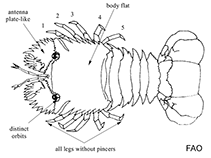
It has carapce lengths of 5 to 12 cm (Ref.4). Found in depths between 45 and 200 m. Little is known about the substrate on which the animals live, except for one record from a sandy bottom (Ref. 4). In general, Scyllarides sp. inhabits the intertidal zone; many prefer rocky substrates while others are on muddy or sandy bottoms (Ref. 106789). Scyllarids are mainly carnivorous scavengers preferring small benthic invertebrates (Ref. 106995).
Mating behavior: Precopulatory courtship ritual is common (through olfactory and tactile cues); usually indirect sperm transfer (Ref. 833).
Holthuis, L.B. 1991 FAO Species Catalogue. Vol. 13. Marine lobsters of the world. An annotated and illustrated catalogue of species of interest to fisheries known to date. FAO Fish. Synop. 125(13):292p. Rome: FAO. (Ref. 4)
Status op de Rode Lijst van het IUCN
(Ref. 130435: Version 2025-2 (Global))
CITES status (Ref. 108899)
Not Evaluated
Not Evaluated
Gevaar voor de mens
Gebruik door de mens
Visserij: van geen belang
FAO - Publication: search | FishSource |
Tools
Meer informatie
Trofische ecologieVoedsel (prooien)
Dieetsamenstelling
Voedselconsumptie
Predatoren
FysiologieZuurstofverbruik
Menselijk gerelateerdPostzegels, munten, diversen.
Internetbronnen
Schattingen op basis van modellen
Kwetsbaarheid van de visserij
(Ref. 71543) |
Moderate vulnerability (38 of 100). |
Prijsklasse
(Ref. 80766): |
Very high. |