Hexactinellida |
Lyssacinosida |
Rossellidae
Environnement : milieu / zone climatique / profondeur / gamme de distribution
Écologie
Sessile; profondeur 30 - 40 m (Réf. 116837). Polar
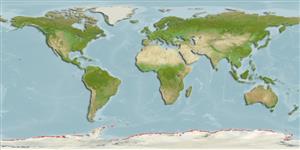
Antarctic.
Longueur à la première maturité / Taille / Poids / Âge
Maturité: Lm ? range ? - ? cm
Description synthétique
Morphologie
White. Often vase- or pear-shape up to 2 m in height, at least 1 m in width. Conspicuous pores present on surface, especially on inner surface (Ref. 89939).
Commensal with amphipods and other arthropods, pycnogonans, shrimps, starfishes and worms. Long-lived (Ref. 124747) and slow growing (Refs. 89939, 124747).
Cycle de vie et comportement reproducteur
Maturité | Reproduction | Frai | Œufs | Fécondité | Larves
Members of the class Hexactinellida are hermaphroditic. Life cycle: The zygote develops into trichimella larva (free-swimming) before settling down on a substrate where it grows into a young sponge.
Danis, B. 2050 A field guide to Antarctic sponges. Antarctic Field Guide. SCAR-MarBIN and ANTABIF. www.afg.org. (Réf. 89939)
Statut dans la liste rouge de l'IUCN
(Réf. 130435: Version 2025-2 (Global))
statut CITES (Réf. 108899)
Not Evaluated
Not Evaluated
Menace pour l'homme
Harmless
Utilisations par l'homme
FAO - Publication: search | FishSource |
Outils
Plus d'informations
Écologie trophiqueAliments (proies)
Composition du régime alimentaire
Consommation alimentaire
Prédateurs
Dynamique des populationsCroissanceÂges / tailles maximalesLongueur-poids rel.Rel. longueur-longueur.Fréquences de longueursConversion de masseAbondance Cycle de vieReproductionMaturitéFéconditéFraiŒufsDéveloppement de l'œufLarves PhysiologieConsommation d'oxygène
Liées à l'hommeTimbres, pièces de monnaie, divers
Sources Internet
Estimations basées sur des modèles
Vulnérabilité de la pêche
(Réf. 71543) |
(0 of 100). |