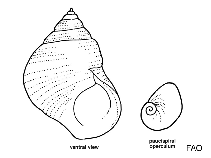
Gastropoda |
Littorinimorpha |
Littorinidae
Environnement : milieu / zone climatique / profondeur / gamme de distribution
Écologie
Benthic; saumâtre. Tropical
Indian Ocean.
Longueur à la première maturité / Taille / Poids / Âge
Maturité: Lm ? range ? - ? cm
Occurs on a wide range of hard substrata in the uppermost eulittoral zone and low littoral fringe. Found on limestone, beach rock, and concrete sea walls. Also on the trunks and pneumatophores of the mangrove Avicennia and among saltmarsh plants, over firm sand and mud surfaces at low tide (Ref. 82584). Abundant in rock crevices in the littoral fringe (Ref. 102838). Members of the family Littorinidae are herbivores, feeding on algae which they graze with a powerful radula (Ref. 349).
Cycle de vie et comportement reproducteur
Maturité | Reproduction | Frai | Œufs | Fécondité | Larves
Members of the order Neotaenioglossa are mostly gonochoric and broadcast spawners. Life cycle: Embryos develop into planktonic trocophore larvae and later into juvenile veligers before becoming fully grown adults.
Williams, S.T. and D.G. Reid 2004 Speciation and diversity on tropical rocky shores: a global phylogeny of snails of the genus Echinolittorina. Evolution 58(10): 2227-2251. (Réf. 94157)
Statut dans la liste rouge de l'IUCN
(Réf. 130435: Version 2025-2 (Global))
statut CITES (Réf. 108899)
Not Evaluated
Not Evaluated
Menace pour l'homme
Harmless
Utilisations par l'homme
FAO - Publication: search | FishSource |
Outils
Plus d'informations
Écologie trophiqueAliments (proies)
Composition du régime alimentaire
Consommation alimentaire
Prédateurs
Dynamique des populationsCroissance
Âges / tailles maximales
Longueur-poids rel.
Rel. longueur-longueur.
Fréquences de longueurs
Conversion de masse
Abondance
Cycle de vieReproductionMaturitéFéconditéFraiŒufsDéveloppement de l'œufLarves PhysiologieConsommation d'oxygène
Liées à l'hommeTimbres, pièces de monnaie, divers
Sources Internet
Estimations basées sur des modèles
Vulnérabilité de la pêche
(Réf. 71543) |
(0 of 100). |