Polychaeta |
Terebellida |
Ampharetidae
Umwelt: Milieu / Klimazone / Tiefenbereich / Verbreitungsgebiet
Ökologie
Benthic; tiefenbereich 26 - 1957 m (Ref. 96345). Polar
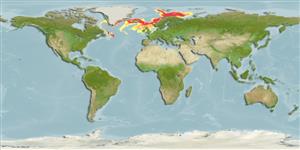
North Atlantic: Greenland and Iceland.
Länge bei der ersten Reifung / Größe / Gewicht / Alter
Geschlechtsreife: Lm ? range ? - ? cm
Body short; longest complete specimen about 11 mm long and 0.5 mm wide. Body tapering
towards posterior end. No eyespots observed. Long buccal tentacles, with long papillae. Four pairs of long branchiae, with dense tufts of cilia, arranged in two groups very close to each other. No paleae. Fourteen thoracic chaetigers; first two chaetigers with slightly less developed notopodia and bristles; posterior twelve thoracic chaetigers also with neuropodia and uncini. Sixteen abdominal segments with uncinigerous neuropodia, first two abdominal uncinigerous tori of thoracic-type lacking dorsal cirri and posterior 14 abdominal neuropodia of different shape and with dorsal cirri. Rudimentary notopodia absent. Abdominal uncini similar to thoracic ones, with 2 vertical rows of 3 teeth above rostrum. Pygidium with two lateral cirri and about 10 capitate papillae. Colour in alcohol pale yellow.
A surface deposit feeder (Ref. 96435).
Lebenszyklus und Paarungsverhalten
Geschlechtsreife | Fortpflanzung | Ablaichen | Eier | Fruchtbarkeit | Larven
Members of the class Polychaeta are mostly gonochoric (sexual). Mating: Females produce a pheromone attracting and signalling the males to shed sperm which in turn stimulates females to shed eggs, this behavior is known as swarming. Gametes are spawned through the metanephridia or body wall rupturing (termed as "epitoky", wherein a pelagic, reproductive individual, "epitoke", is formed from a benthic, nonreproductive individual, "atoke"). After fertilization, most eggs become planktonic; although some are retained in the worm tubes or burrowed in jelly masses attached to the tubes (egg brooders). Life Cycle: Eggs develop into trocophore larva, which later metamorph into juvenile stage (body lengthened), and later develop into adults.
Parapar, J., G.V. Helgason, I. Jirkov and J. Moreira 2012 Polychaetes of the genus Ampharete (Polychaeta: Ampharetidae) collected in Icelandic waters during the BIOICE project. Helgoland Marine Research 66(3):331-344. (Ref. 96435)
IUCN Rote Liste Status
(Ref. 130435: Version 2025-2 (Global))
CITES Status (Ref. 108899)
Not Evaluated
Not Evaluated
Bedrohung für Menschen
Harmless
Nutzung durch Menschen
FAO - Publication: search | FishSource |
Tools
Mehr Information
Trophische ÖkologieLebensmittel (Beutetiere)
Nahrungszusammensetzung
Nahrungsaufnahme
Räuber
PopulationsdynamikWachstum
Max. Alter/Größen
Länge-Gewicht-Rel.
Länge-Länge-Verhältnis.
Längenhäufigkeiten
Massenkonvertierung
Dichte
LebenszyklusFortpflanzungGeschlechtsreifeFruchtbarkeitAblaichenEierEientwicklungLarven PhysiologieSauerstoffverbrauch
MenschenbezogenBriefmarken, Münzen, Verschiedenes.
Internet Quellen
Schätzungen auf der Grundlage von Modellen
Anfälligkeit der Fischerei
(Ref. 71543) |
(0 of 100). |